The Nature of Human Creation in the Light of Islamic Education
DOI:
https://doi.org/10.67046/jietd.v1i1.13Keywords:
human; Islamic education; morals, nature of creation.Abstract
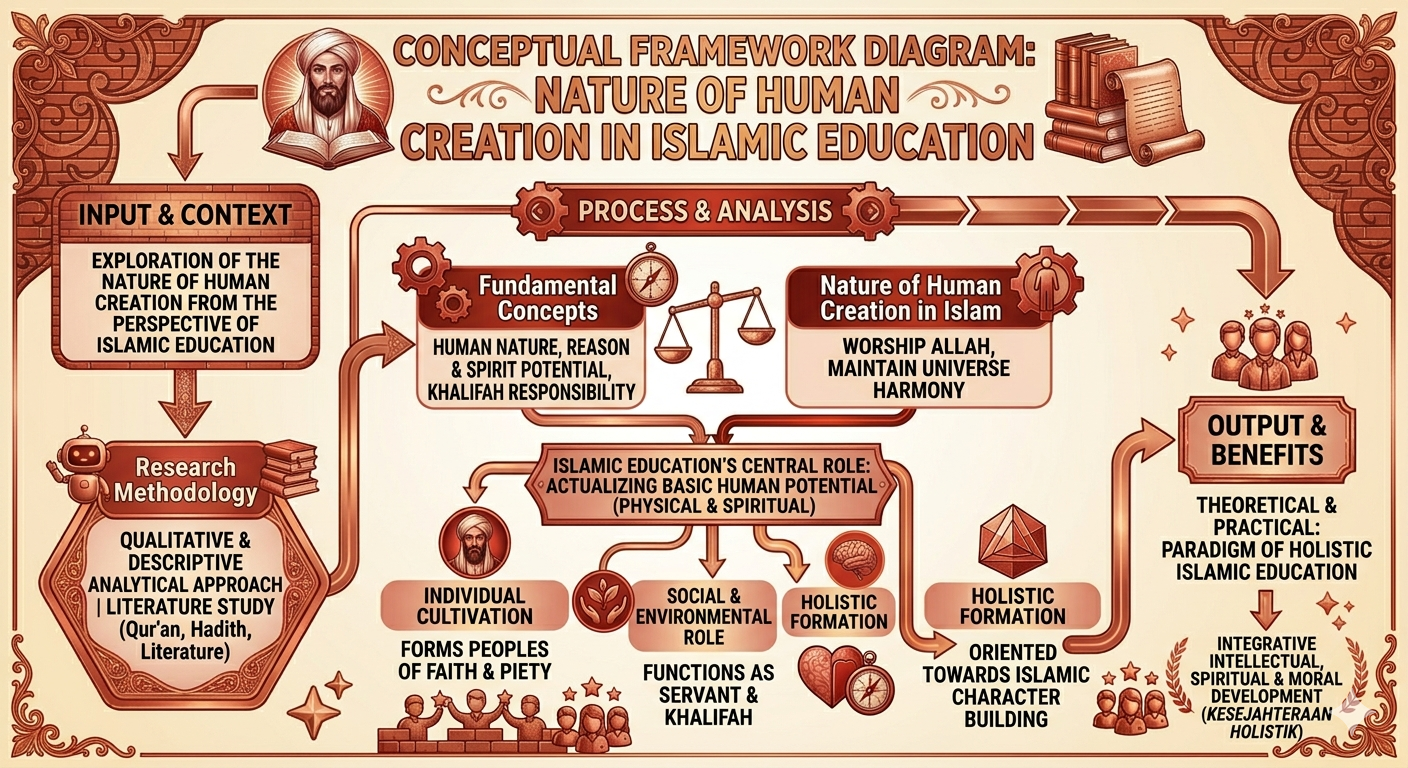
This article examines the nature of human creation in the perspective of Islamic Education by using descriptive analytical research methods that are qualitative in nature. This research aims to understand the essence of human creation as a creature of Allah SWT and its relevance to the goals of Islamic education, namely to form people of faith, piety, and noble character. Data were collected through a literature study by referring to primary sources such as the Qur'an, Hadith, as well as classical and contemporary literature related to Islamic education and the philosophy of human creation. Data analysis was conducted critically and in-depth to explore fundamental concepts about human nature, the potential of reason and spirit, and human responsibility as khalifah fil ard. The results show that the nature of human creation in Islam is to fulfill the divine purpose, namely to worship Allah and maintain the harmony of the universe. Islamic education has a central role in actualizing the basic human potential (physical and spiritual) so that it is able to carry out its function as a servant and khalifah. This article concludes that a deep understanding of the nature of human creation is an important foundation in formulating an Islamic education paradigm that is holistic, integrative, and oriented towards Islamic character building. Thus, Islamic education does not only focus on intellectual aspects but also spiritual and moral.
References
Afkarina, R. H., & Kurniawan, R. R. (2022). Proses Penciptaan Manusia Menurut Ilmu Sains dan Al-Qur’an. Ulumul Qur’an: Jurnal Ilmu Al-Qur’an dan Tafsir Volume. https://doi.org/10.31219/osf.io/w8c2p
Aliyah, Adah, Adang Hambali, and Andewi Suhartini, ‘Konsep Penciptaan Manusia (Khaliqul Basyar) Sebagai Landasan Religious Pendidikan Islam’, Ta’allum: Jurnal Pendidikan Islam, 11.1 (2023), 188–205 https://doi.org/10.21274/taalum.2023.11.1.188-205
Auliaz, Isma, ‘Hakikat Manusia dan Implikasinya Terhadap Pendidikan Islam’, EDU-RILIGIA: Jurnal Ilmu Pendidikan Islam Dan Keagamaan, 7.3 (2023), 192 https://doi.org/10.47006/er.v7i3.16184
Gasmi, N. M., Oktaviana, S., & Afifah, U. (2025). Strategi Integratif dalam Pendidikan Islam: Pendekatan Holistik Terhadap Islamisasi Kolaboratif dan Kontekstual Sains Melalui Metode Pembelajaran Kolaboratif dan Kontekstual. Action Research Journal indonesia (ARJI).
Rasyad, Rasyad, ‘Konsep Khalifah dalam Al-Qur’an (Kajian Ayat 30 Surat Al-Baqarah Dan Ayat 26 Surat Shaad)’, Jurnal Ilmiah Al-Mu’ashirah, 19.1 (2022), 20 https://doi.org/10.22373/jim.v19i1.12308
Rizal, Syamsul, ‘Melacak Terminologi Manusia Dalam Al-Qur’an’, Jurnal At-Tibyan, 2 no.2 (2017) <https://doi.org/https://doi.org/10.32505/at-tibyan.v2i2.391>
Rudiansyah, Dwi Noviani, and Rani Anggraini, ‘Pemikiran Tentang Hubungan Manusia Dengan Pendidikan Islam’, Journal of Social Humanities and Education, 02.04 (2023), 116–26
Shofiyah, Nida, Sumedi Sumedi, Tatang Hidayat, and Istianah Istianah, ‘Tujuan Penciptaan Manusia Dalam Kajian Al-Quran’, ZAD Al-Mufassirin, 5.1 (2023), 1–17 https://doi.org/10.55759/zam.v5i1.54
Suaidi, ‘Urgensi Pendidikan Anak Dalamn Upaya Meraih Kesuksesan Di Masa Depan’, AT-TAWASSUTH: Jurnal Ekonomi Islam, VIII.I (2023), 1–19
Wahyuni, Dewi, ‘Penanaman Akidah Islam Sejak Dini Pada Siswa Di Madrasah Ibtidaiyah’, Al-Ihtirafiah: Jurnal Ilmiah Pendidikan Guru Madrasah Ibtidaiyah, 3.01 (2023), 38–47 https://doi.org/10.47498/ihtirafiah.v3i01.1768
Downloads
Published
How to Cite
Issue
Section
License
Copyright (c) 2025 The Author (S).

This work is licensed under a Creative Commons Attribution-ShareAlike 4.0 International License.
Copyright Notice
Authors who publish in the Journal of Islamic Education Thought and Development agree to the following terms:
- Copyright Ownership
Authors retain the copyright of their published work and grant the Journal of Islamic Education Thought and Development the right of first publication. - Creative Commons License
The published work is simultaneously licensed under the Creative Commons Attribution 4.0 International License (CC BY 4.0), which permits others to copy, distribute, adapt, and build upon the work, provided appropriate credit is given to the original author(s) and the journal as the initial publisher. - Additional Distribution Rights
Authors may enter into separate, additional contractual arrangements for the non-exclusive distribution of the published version of the work, such as depositing it in an institutional repository, publishing it in a book, or sharing it through other academic platforms, provided that acknowledgment is made of its initial publication in the Journal of Islamic Education Thought and Development. - Self-Archiving Policy
Authors are permitted and encouraged to post their manuscripts online, including in institutional repositories, personal websites, or academic networking platforms, both before and during the submission process. - Benefits of Early Dissemination
Early online dissemination of research may facilitate scholarly exchange, increase visibility, and contribute to earlier and broader citation of published articles.