Traditional Ethics in the Use of AI for Arabic Language Education: An Aristotelian Philosophy Perspective
DOI:
https://doi.org/10.67046/jietd.v1i1.4Keywords:
Arabic language education; Artificial intelligence; Aristotelian ethics; Eudaimonia; Phronesis.Abstract
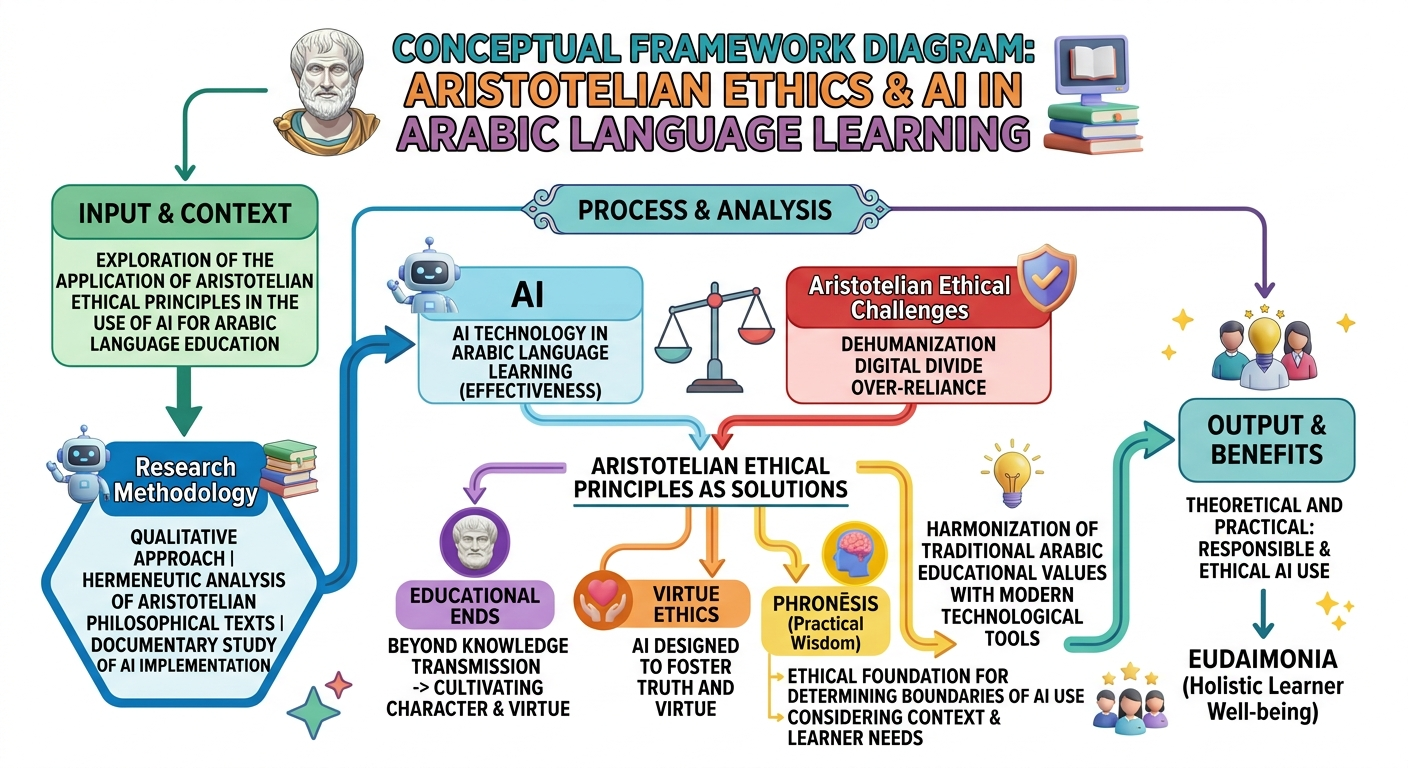
This research explores the application of Aristotle's ethical principles in the use of artificial intelligence (AI) for Arabic language education. Using a qualitative approach, data were collected through a hermeneutic analysis of Aristotle's philosophical texts and a documentary study of the implementation of AI in Arabic language learning. The findings show that although AI can enhance the effectiveness of Arabic language teaching, it also presents challenges such as dehumanization, digital divide, and over-reliance on technology, from Aristotle's ethical perspective, these challenges highlight the importance of carefully considering the ultimate goal of education. Applying the principles of virtue ethics, this study proposes that AI should be designed not only to transmit knowledge, but also to cultivate students' character and virtues. The concept of phronēsis (practical wisdom) is introduced as an ethical foundation for determining appropriate boundaries in the use of AI, encouraging educators to consider the context and specific needs of learners when integrating technology. This research offers theoretical and practical insights into how traditional values in Arabic language education can be harmonized with modern technological tools to achieve eudaimonia, a state of holistic well-being for learners.
References
Alwi, S., Syukran, S., & Sari, M. (2024). Internalization of character education values in Arabic language learning at Islamic boarding school in Indonesia. Al-Ta’rib: Jurnal Ilmiah Program Studi Pendidikan Bahasa Arab IAIN Palangka Raya, 12(1), 89–102. https://doi.org/10.23971/altarib.v12i1.7882
Anwar, M. R. (2023). AI-powered Arabic language education in the era of Society 5.0. IAIC Transactions on Sustainable Digital Innovation, 5(1), 50–57. https://doi.org/10.34306/itsdi.v5i1.607
Asy’arie, B. F., Rahma, S. Z. N., & Fuat, Z. (2024). Exploring the impact of humanistic theory on Arabic language learning at MIN 2 East Lampung. Al-Jawhar: Journal of Arabic Language, 2(1), 30–45.
Bolandhematan, K. (2019). Spiritual education in Islamic tradition: Revisiting Ghazali’s “Deliverance.” Religious Education, 114(2), 110–129.
Chen, L., Chen, P., & Lin, Z. (2020). Artificial intelligence in education: A review. IEEE Access, 8, 75264–75278. https://doi.org/10.1109/access.2020.2988510
Dowling, M. (2004). Hermeneutics: An exploration. Nurse Researcher, 11(4).
Eisikovits, N., & Feldman, D. (2022). AI and phronesis. Moral Philosophy and Politics, 9(2), 181–199.
Gunawan, R., & Hidayatullah, M. S. (2024). The potential of use artificial intelligence in implementing character education in Arabic language subjects. Asalibuna, 8(1), 39–51.
Hanandeh, A., Ayasrah, S., Kofahi, I., & Qudah, S. (2024). Artificial intelligence in Arabic linguistic landscape: Opportunities, challenges, and future directions. TEM Journal, 3137–3145. https://doi.org/10.18421/tem134-48
Heidegger, M. (2009). Basic concepts of Aristotelian philosophy. Indiana University Press.
Jurāne-Brēmane, A. (2023). Digital assessment in technology-enriched education: Thematic review. Education Sciences, 13(5), 522. https://doi.org/10.3390/educsci13050522
Khalidi, T. (1994). Arabic historical thought in the classical period. Cambridge University Press.
Kinsella, E. A., & Pitman, A. (2012). Phronesis as professional knowledge: Practical wisdom in the professions (Vol. 1). Springer Science & Business Media.
Kyriacou, C. (2024). Artificial moral intelligence and computability: An Aristotelian perspective. AI and Ethics, 1–18.
Lawrenz, J. (2021). Confucius, Aristotle, and the golden mean: A diptych on ethical virtues. The European Legacy, 26(2), 149–169.
Mufid, M., & Diantika, D. E. (2024). Integrasi 10 kategori Aristoteles dalam pembelajaran ilmu Nahwu: Sebuah analisis interdisipliner. Al-Muktamar As-Sanawi Li Al-Lughah Al-’Arabiyyah (MUSLA), 2(1), 45–55.
Nuryadin, R., Irfan, N., & Layinah, L. (2024). Systematic literature review: Strategi pembelajaran bahasa Arab ilmu Sharaf berdasarkan teori pembelajaran terpadu. Jurnal Pendidikan dan Pembelajaran Indonesia (JPPI), 4(4), 1371–1385. https://doi.org/10.53299/jppi.v4i4.738
Rahmaddani, A. (2025). Students’ Perspectives on the Use of Chat-GPT in the Fields of Phonology, Morphology, and Syntactics in Arabic Language Learning. Journal of Islamic Education Thought and Development, 1(1), 48-61.
Rifky, S. (2024). Dampak penggunaan artificial intelligence bagi pendidikan tinggi. IJMST, 2(1), 37–42. https://doi.org/10.31004/ijmst.v2i1.287
Rohmawaty, E. N., Hilmi, D., Uqba, M. S. S., & Saleh, U. S. (2024). Peran artificial intelligence (AI) dalam pembelajaran bahasa Arab mahasiswa Pascasarjana UIN Maulana Malik Ibrahim Malang. Khatulistiwa: Jurnal Pendidikan dan Sosial Humaniora, 4(3), 316–328.
Saidi, A. I. (2008). Hermeneutika, sebuah cara untuk memahami teks. Jurnal Sosioteknologi, 7(13), 376–382.
Salam, M. Y., Fitri, S., & Zulan, H. (2024). Educational technology based on artificial intelligence in supporting distance learning in Arabic language learning in higher education. Journal International of Lingua and Technology, 3(1), 134–145. https://doi.org/10.55849/jiltech.v3i1.485
Saugstad, T. (2002). Educational theory and practice in an Aristotelian perspective. Scandinavian Journal of Educational Research, 46(4), 373–390.
Siapka, A. (2023). AI-driven automation as a pre-condition for eudaimonia. In Proceedings of the 2023 AAAI/ACM Conference on AI, Ethics, and Society (pp. 993–994).
Sison, A. J. G., & Redín, D. M. (2023). A neo-Aristotelian perspective on the need for artificial moral agents (AMAs). AI & Society, 38(1), 47–65.
Stenberg, K., & Maaranen, K. (2020). Promoting practical wisdom in teacher education: A qualitative descriptive study. European Journal of Teacher Education, 45(5), 617–633. https://doi.org/10.1080/02619768.2020.1860012
Supriyanto, S., & Toifah, N. (2024). Efektivitas penggunaan artificial intelligence (AI) dalam pembelajaran bahasa Arab di era society 5.0: Systematic literature review. Lugawiyyat, 6(2), 42–54.
Tsabatiyya, N. H., Muthohar, S., & Sanie, A. (2025). The Values of Nationalism Education in the Songs Yalal Wathon and Sang Surya: August Comte's Perspective. Journal of Islamic Education Thought and Development, 1(1), 1-12.
Widayanti, R., & Yelfi, D. (2019). Metodologi penelitian kualitatif pendidikan bahasa Arab.
Wu, T. (2024). Virtual research laboratory in foreign language teaching: Strategies and role. Scientific Bulletin of Mukachevo State University Series “Pedagogy and Psychology, 10(1), 107–115. https://doi.org/10.52534/msu-pp1.2024.107
Downloads
Published
How to Cite
Issue
Section
License
Copyright (c) 2025 The Author (S).

This work is licensed under a Creative Commons Attribution-ShareAlike 4.0 International License.
Copyright Notice
Authors who publish in the Journal of Islamic Education Thought and Development agree to the following terms:
- Copyright Ownership
Authors retain the copyright of their published work and grant the Journal of Islamic Education Thought and Development the right of first publication. - Creative Commons License
The published work is simultaneously licensed under the Creative Commons Attribution 4.0 International License (CC BY 4.0), which permits others to copy, distribute, adapt, and build upon the work, provided appropriate credit is given to the original author(s) and the journal as the initial publisher. - Additional Distribution Rights
Authors may enter into separate, additional contractual arrangements for the non-exclusive distribution of the published version of the work, such as depositing it in an institutional repository, publishing it in a book, or sharing it through other academic platforms, provided that acknowledgment is made of its initial publication in the Journal of Islamic Education Thought and Development. - Self-Archiving Policy
Authors are permitted and encouraged to post their manuscripts online, including in institutional repositories, personal websites, or academic networking platforms, both before and during the submission process. - Benefits of Early Dissemination
Early online dissemination of research may facilitate scholarly exchange, increase visibility, and contribute to earlier and broader citation of published articles.