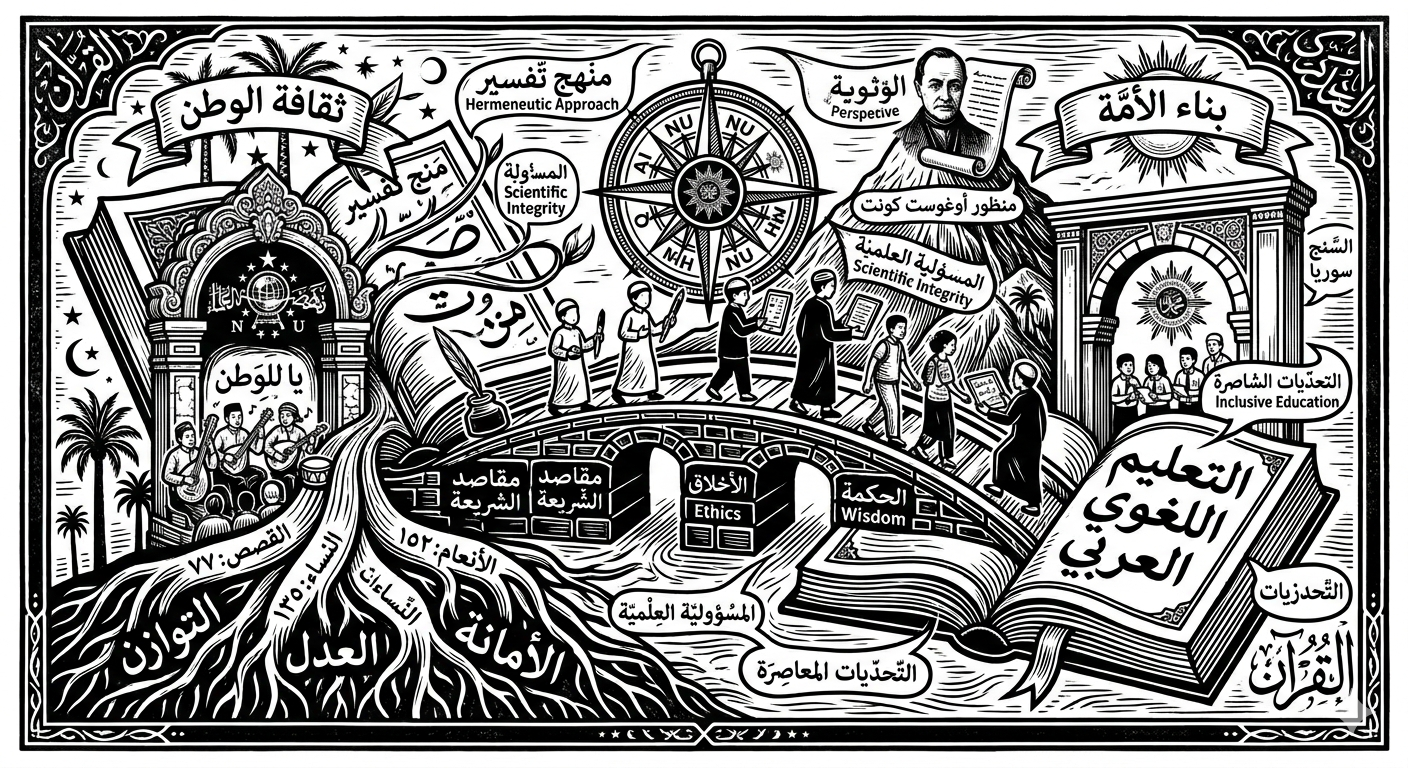
The Values of Nationalism Education in the Songs Yalal Wathon and Sang Surya: August Comte's Perspective
DOI:
https://doi.org/10.67046/jietd.v1i1.5Keywords:
August Comte; nationalism; Sang Surya; struggle songs; Yalal WathonAbstract
This study aims to analyze the values of education nationalism contained in two Indonesian struggle songs, namely Yalal Wathon and Sang Surya, through the perspective of August Comte's philosophy, especially the theory of Positivism. The research method uses a qualitative approach with a literature study method. The findings of this study indicate that the lyrics of the song reflect three stages of human thought development according to Comte, namely the theological, metaphysical, and positive stages. This study found that Yalal Wathon emphasizes the emotional religious aspect (theological stage), while Sang Surya tends to emphasize rationality and scientific optimism in building the nation (positive stage). Although different in approach, the two songs have similarities in fostering a sense of love for the homeland and collective solidarity as the foundation of nationalism. This article recommends that the values of nationalism in these songs are not only a tool for political struggle, but also a means of moral and social education for the community, as reflected in the framework of Comte's Positivism which emphasizes the importance of science and social solidarity in the formation of collective identity. This finding contributes to showing that Yalal Wathon emphasizes the emotional-religious aspect (theological stage), while Sang Surya emphasizes scientific rationality and optimism in building the nation (positive stage). Although different in approach, both songs have similarities in fostering a sense of love for the homeland and collective solidarity as the foundation of nationalism. the use of Positivism theory in cultural studies, which allows similar studies that combine art, philosophy, and history in an analytical framework. Overall, this study successfully combines the emotional and rational aspects of nationalism, and shows its relevance for education and the process of forming the nation's collective identity.
References
Afrianingsih, A. (2020). Laying Aswaja’s basic values to print AUD characters in PAUD TBS Kudus . Al Kahfi: Journal of Early Childhood Islamic Education, 2(1), 43–50.
Alifuddin, M. (2023). Muhammadiyah da'wah in building national awareness in Kendari in the pre-independence period: A social movement perspective. Al-Munzir , 13(2), 209–230.
Amrullah, A., & Hadi, A. (2023). Internalization of nationalism values in the learning of ASWAJA and NU-an education in Madrasah Aliyah Nasy’atul Muta’allimin. Ideas: Journal of Educational, Social, and Culture , 9(2), 583–588.
Aynina, R. (2019). History and development of the Syubbanul Wathan song in 1916–2019 . UIN Sunan Ampel Surabaya.
Barakah, F., Ikromatoun, S., Amin, K., & Nusuary, F. M. (2023). Nationalism of santri muallimin Muhammadiyah Yogyakarta. Journal of Sociology of the Archipelago , 9(2), 203–218. https://ejournal.unib.ac.id/jsn/article/view/30237/13810
Fahrudi, E., & Mundzir, M. (2024). The meaning of the song Yaa Lal Wathan in constructing the spirit of nationalism of MI NU Hidayatun Najah Tuban students. Premiere: Journal of Islamic Elementary Education , 6(1), 92–101. https://ejournal.iainutuban.ac.id/index.php/premiere/article/view/940/548
Farih, A. (2016). Nahdlatul Ulama (NU) and its contribution in fighting for independence and defending the Unitary State of the Republic of Indonesia (NKRI). Walisongo: Journal of Socio-Religious Research , 24(2), 251–284.
Gusli, R. A., Hanani, S., Akhyar, M., & Lestari, K. M. (2024). Auguste Comte's perspective on the development of Islamic education at the Nurul Yaqin Islamic boarding school is light. An-Nahdlah: Journal of Islamic Education , 4(2), 404–411.
Irfani, A. (2024). The snake and ladder game as a learning medium for the Quran at TPQ Hikmatun Balighoh . Darussalam, 25(01). https://jurnal.iaidarussalam.ac.id/index.php/darussalam/article/view/20/19
Muhaimin, M. (2021). Yaa lal wathon lyrics: Interpretation of KH Wahab Hasbullah's work in the construction of nationalism of elementary school students. Syaikhuna: Journal of Islamic Education and Institutions , 12(1), 14–25. https://ejournal.kopertais4.or.id/madura/index.php/syaikhuna/article/view/4401/3069
Muzakky, R. (2024). Analisis semiotik nilai-nilai dakwah lagu Syubbanul Wathan pada masyarakat Kecamatan Batanghari Kabupaten Lampung Timur (Doctoral dissertation, IAIN Metro). https://repository.metrouniv.ac.id/id/eprint/10518/
Noviyanti, R. (2019). Nationalism in the perspective of Nahdlatul Ulama (NU). History Flow: Journal of History Education , 2(2). https://journal.lppmunindra.ac.id/index.php/alursejarah/article/view/4242
Pradani, A. Y., & Putra, R. S. T. (2025). The application of the relegicity value of PAI subjects in the formation of students' nationalism attitudes. Pendas: Scientific Journal of Basic Education , 10(01), 221–238. https://journal.unpas.ac.id/index.php/pendas/article/view/23790/11689
Rahim, A. (2013). Nahdatul Ulama (its role and education system). Al-Hikmah Journal for Religious Studies , 14(2), 158–167.
Retnasary, L. (2023). Semantic analysis in the lyrics of the song "Syubbanul Wathan" by KH Abdul Wahab Chasbullah. Bashrah Scientific Journal , 3(02), 86–97.
Setiawan, I. (2018). Islam and nationalism: The views of Islamic education reformers Ahmad Dahlan and Abdulwahab Khasbullah. Hayula: Indonesian Journal of Multidisciplinary Islamic Studies, 2(1), 1–16. https://core.ac.uk/download/pdf/204546921.pdf
Shofwan, A. M., & Arifin, M. (2025). The legacy of Kumbakarna nationalism in the perspective of Islamic teachings. NGAJI: Journal of Islamic Education Studies, 1(1), 18–26. https://ejournal.cahyaedu.com/index.php/ngaji/article/view/5/2
Subawaihin, I. (2024). The snake and ladder game as a learning medium for the Quran at TPQ Hikmatun Balighoh. Darussalam, 25(01). https://jurnal.iaidarussalam.ac.id/index.php/darussalam/article/view/20/19
Zega, E. N. Y., Nella, K., Enok, D., & Hasibuan, N. (2025). Philosophy of positivism according to August Comte from the perspective of theology related to salvation. Journal of Social Education and Humanities , 4(1), 1040–1052. https://publisherqu.com/index.php/pediaqu/article/view/1636/1528
Downloads
Published
How to Cite
Issue
Section
License
Copyright (c) 2025 The authors

This work is licensed under a Creative Commons Attribution-ShareAlike 4.0 International License.
Copyright Notice
Authors who publish in the Journal of Islamic Education Thought and Development agree to the following terms:
- Copyright Ownership
Authors retain the copyright of their published work and grant the Journal of Islamic Education Thought and Development the right of first publication. - Creative Commons License
The published work is simultaneously licensed under the Creative Commons Attribution 4.0 International License (CC BY 4.0), which permits others to copy, distribute, adapt, and build upon the work, provided appropriate credit is given to the original author(s) and the journal as the initial publisher. - Additional Distribution Rights
Authors may enter into separate, additional contractual arrangements for the non-exclusive distribution of the published version of the work, such as depositing it in an institutional repository, publishing it in a book, or sharing it through other academic platforms, provided that acknowledgment is made of its initial publication in the Journal of Islamic Education Thought and Development. - Self-Archiving Policy
Authors are permitted and encouraged to post their manuscripts online, including in institutional repositories, personal websites, or academic networking platforms, both before and during the submission process. - Benefits of Early Dissemination
Early online dissemination of research may facilitate scholarly exchange, increase visibility, and contribute to earlier and broader citation of published articles.