The Use of Mindfulness-Based Interventions in Reducing Test Anxiety Among Students in Nigerian Higher Education
DOI:
https://doi.org/10.67046/jietd.v1i2.69Keywords:
indfulness-based intervention, test anxiety, tertiary institutions, emotional regulationAbstract
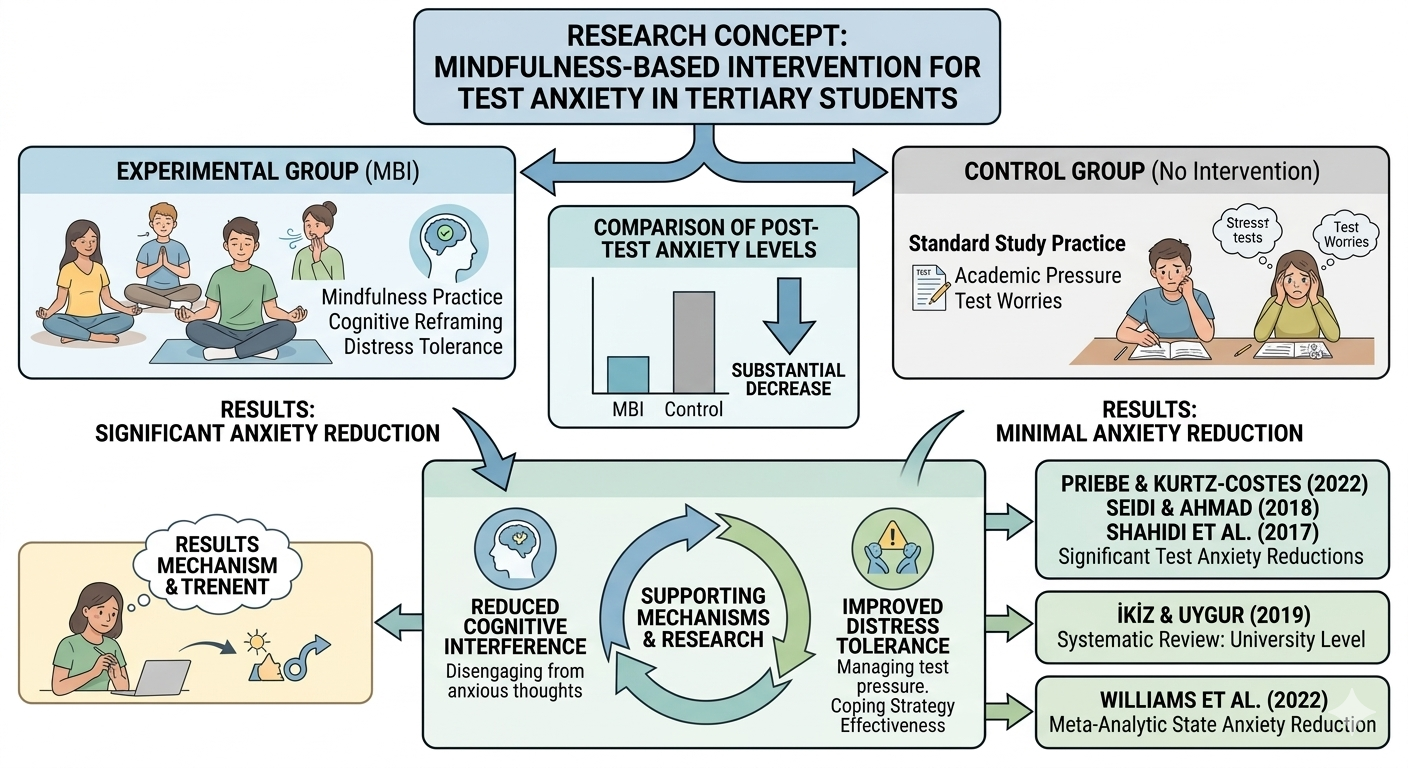
Test anxiety remains a significant psychological challenge among students in tertiary institutions, often interfering with academic performance, concentration, and emotional well-being. This study examined the effectiveness of a mindfulness-based intervention in reducing test anxiety among undergraduate students. A quasi-experimental pretest–posttest control group design was employed. Eighty students with moderate to high levels of test anxiety were selected through screening and randomly assigned to an experimental group (n = 40) and a control group (n = 40). The experimental group participated in an eight-week mindfulness-based intervention adapted from the Mindfulness-Based Stress Reduction (MBSR) model, while the control group continued with regular academic activities. Data were collected using the Test Anxiety Inventory and analyzed using descriptive statistics, paired samples t-tests, independent samples t-tests, and analysis of covariance (ANCOVA). Findings revealed a statistically significant reduction in test anxiety among students who participated in the mindfulness program compared to those in the control group (p < 0.05). The intervention demonstrated a large effect size, indicating substantial practical impact. The results suggest that mindfulness-based interventions can effectively enhance emotional regulation and reduce anxiety in evaluative academic settings. The study concludes that integrating structured mindfulness programs into tertiary education may serve as a valuable preventive and supportive strategy for addressing test anxiety and promoting student well-being.
References
Chen, X., Zhang, B., Jin, S., Quan, Y., Zhang, X., & Cui, X. (2021). The effects of mindfulness-based intervention on nursing students: A meta-analysis. Nurse Education Today, 98, 104718. https://doi.org/10.1016/j.nedt.2020.104718
Hui, Y. & Yijie, L. (2025). The role of mindfulness in foreign language anxiety: A systematic review of correlation and intervention studies. International Journal of Mental Health Promotion, 27(9), 1279-1300.
İkiz, F. E., & Uygur, S. S. (2019). The effects of mindfulness-based programs on coping with test anxiety: A systematic review. International Journal of Human Sciences, 16(1), 164-191.
Innab, A., Al-Khunaizi, A., Al-Otaibi, A. & Moafa, H. (2023). Effects of mindfulness-based childbirth education prenatal anxiety: A quasi-experimental study. Acta Psychologica, 238, 103978. https://doi.org/10.1016/jactpsy.2023.103978
Khaira, M.K., Gopal, R.L.R, Saini, S.M. & Isa, Z.M. (2023). Interventional strategies to reduce test anxiety among nursing students: A systematic review. International Journal of Environmental Research and Public Health, 20(2), 1233.
Kim, E., Laine, T. H., & Lee, Y. (2025). Mitigating stress and anxiety in a social VR-based Trier Social Stress Test: The role of trait anxiety in cognitive and mindfulness interventions. Acta Psychologica, 259, 105361. https://doi.org/10.1016/j.actpsy.2025.105361
Li H., Lu M., Wang M., Peng Y., Wang X., Chen D. (2026). The efficacy of Mindfulness-based intervention in reducing emotional inertia in patients with depression: An empirical study. International Journal of Africa Nursing Sciences, 24, https://doi.org/10.1016/j.ijans.2026.100986
Moreno-Gomez, A., Luma, P., Garcia-Diego, C., Rodringuez-Donaire, A., & Cejudo, J. (2023). Exploring the effects of a mindfulness-based intervention in university students: Mindkinder adult version program (MK-A). Evaluation and Program Planning, 97, 102252. https://doi.org/10.1016/j.evalprogplan.2023.102252
Priebe, N. P. & Kurtz-Costes, B. (2022). The effect of mindfulness programs on collegiate test anxiety. Mindfulness, 13, 2868-2878. https://doi.org/10.1007/s12671-022-02002-6
Rahmaddani, A. (2025). Students’ Perspectives on the Use of Chat-GPT in the Fields of Phonology, Morphology, and Syntactics in Arabic Language Learning. Journal of Islamic Education Thought and Development, 1(1), 48-61.
Ratih. A. L., Annisa A., Nyda, A., Elya M., Nurul H., Achmad S., Rizky B. N., Michelle L. M., Alison E.J. Mahoney, J. M. N. (2025). A culturally adapted internet-delivered mindfulness intervention with counsellor guidance for reducing distress among Indonesian university students: A randomised waitlist-controlled trial. Behaviour Research and Therapy, 193, https://doi.org/10.1016/j.brat.2025.104827
Seidi, P. A., & Ahmad, M. M. (2018). The effect of mindfulness-based stress reduction on the test anxiety of students at university of Garmian. Journal of Garmian University, 5(3), 465-474. https://doi.org/10.24271/garmian.384
Shahidi, S., Akbari, A., & Zargar, F. (2017). Effectiveness of mindfulness-based stress reduction on emotion regulation and test anxiety in female high school students. Journal of Education and Health Promotion, 6. https://doi.org/10.4103/jehp.jehp_96_16
Simonsson, O., Bazin, O., Fisher, S. D., & Goldberg, S. B. (2021). Effects of an eight-week online mindfulness program on university students’ mental health during COVID-19. Psychiatry Research, 305, 114222. https://doi.org/10.1016/j.psychres.2021.114222
Torné-Ruiz, A., Navarro-Abal, Y., & Climent-Rodríguez, J. A. (2023). Effectiveness of an intensive online mindfulness-based intervention in reducing stress and anxiety during clinical simulation in nursing students. Nurse Education in Practice, 66, 103533. https://doi.org/10.1016/j.nepr.2022.103533
Vern, C. H., Yan-Li, S. & Azmawaty, M. N. (2025). A systematic review of mindfulness-based stress reduction in the management of anxiety disorders among adolescents and young adults aged 13–26. Asian Journal of Psychiatry, 108, 104497. https://doi.org/10.1016/j.ajp.2025.104497
Wijaya, B. R., & Suja'i, S. I. (2025). Traditional Ethics in the Use of AI for Arabic Language Education: An Aristotelian Philosophy Perspective. Journal of Islamic Education Thought and Development, 1(1), 13-30.
Williams, M., McManus, F., Muse, K., & Williams, J. M. G. (2022). Mindfulness induction for anxiety: A systematic review and meta-analysis of acute effects on state anxiety and attention. Clinical Psychology Review.
Yanjuan L., Mengyao H., Zhenzhen W., Stefan G. H., Xinghua L., (2024). Distress tolerance as a mediator of mindfulness-based intervention for anxiety and depression: Evidence from two randomized controlled trials. International Journal of Clinical and Health Psychology, 24(2). https://doi.org/10.1016/j.ijchp.2024.100445
Young, D. K., Carlbring, P., Ng, P. Y., Cheng, D. Y. T., Chen, J. Q. & Ng, S. (2023). Low intensity online mindfulness-based intervention for university students with anxiety during covid-19 pandemic – A randomized controlled trial with 3-month follow-up. Internet Intervention, 34, 100665. https://doi.org/10.1016/j.invent.2023.100165
Zeng, X., Zhang, Y., Chu, Z., & Chen, T. (2025). Nature-based mind-body intervention for test anxiety in adolescents: A feasibility study. Frontiers Psychology 16:1550353.
Downloads
Published
How to Cite
Issue
Section
License
Copyright (c) 2026 The Author (S).

This work is licensed under a Creative Commons Attribution-ShareAlike 4.0 International License.
Copyright Notice
Authors who publish in the Journal of Islamic Education Thought and Development agree to the following terms:
- Copyright Ownership
Authors retain the copyright of their published work and grant the Journal of Islamic Education Thought and Development the right of first publication. - Creative Commons License
The published work is simultaneously licensed under the Creative Commons Attribution 4.0 International License (CC BY 4.0), which permits others to copy, distribute, adapt, and build upon the work, provided appropriate credit is given to the original author(s) and the journal as the initial publisher. - Additional Distribution Rights
Authors may enter into separate, additional contractual arrangements for the non-exclusive distribution of the published version of the work, such as depositing it in an institutional repository, publishing it in a book, or sharing it through other academic platforms, provided that acknowledgment is made of its initial publication in the Journal of Islamic Education Thought and Development. - Self-Archiving Policy
Authors are permitted and encouraged to post their manuscripts online, including in institutional repositories, personal websites, or academic networking platforms, both before and during the submission process. - Benefits of Early Dissemination
Early online dissemination of research may facilitate scholarly exchange, increase visibility, and contribute to earlier and broader citation of published articles.