Deferred Aspirations and Structural Poverty
Psychological-Spiritual Barriers and Community-Based Empowerment in Islamic Education Among Rural Youth in Indonesia
DOI:
https://doi.org/10.67046/jietd.v1i2.73Keywords:
structural poverty, rural islamic education, youth educational aspirations, zakat-based community empowermentAbstract
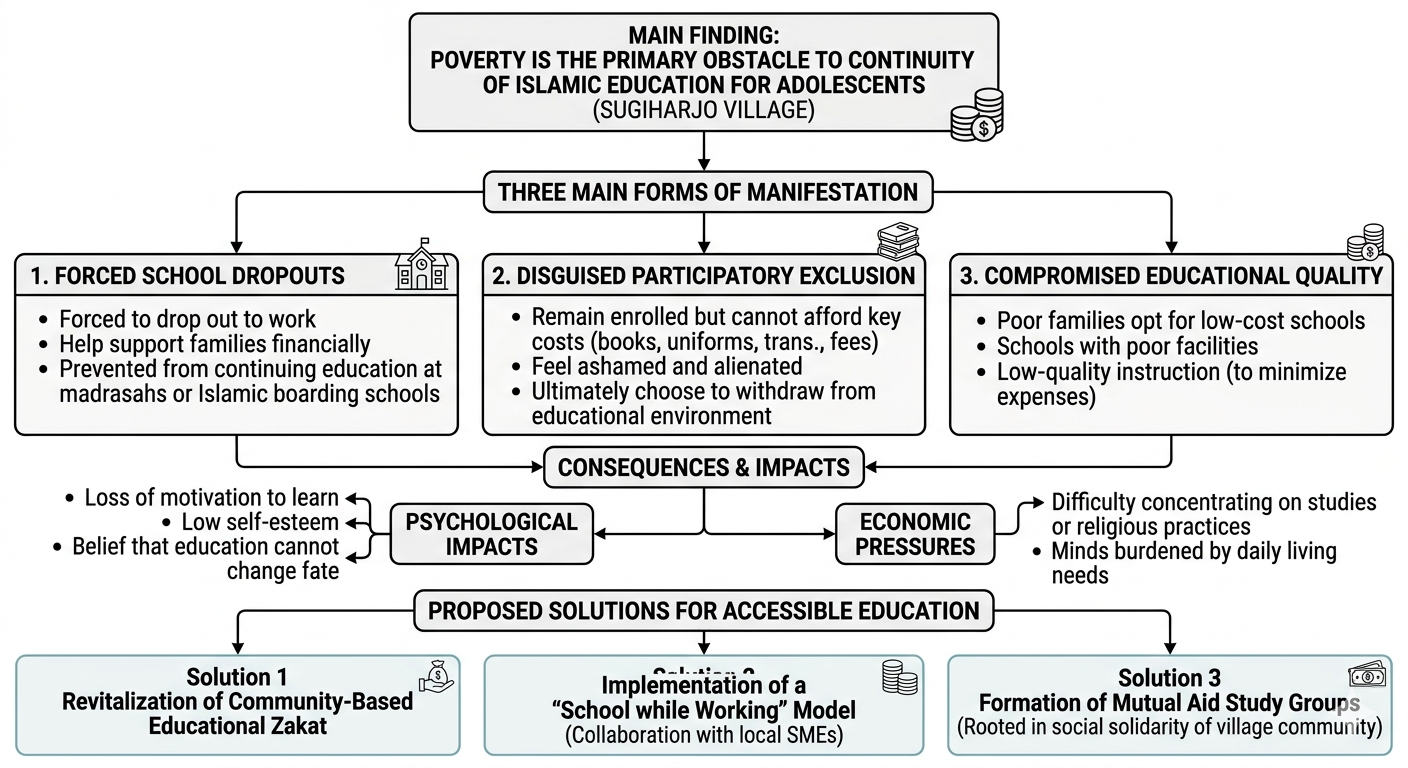
This research seeks to investigate the phenomenon of “deferred aspirations” caused by financial limitations that obstruct the accessibility and development of Islamic education among youth in Sugiharjo Village, Tuban Regency, East Java, Indonesia, through a qualitative case study approach involving 8 informants at the research site in Sugiharjo, Tuban, Indonesia consisting of adolescents, parents, teachers, religious leaders, and community representatives. Data were collected through informal interviews, participatory observation, and document analysis, then analyzed using the Miles and Huberman framework. The findings reveal that poverty is not merely an economic barrier but also a structural mechanism that triggers a multidimensional educational decline, reflected in phenomena such as “forced school exits,” “hidden participation exclusion,” and “quality compromises,” where students remain formally enrolled yet experience limited access to meaningful educational opportunities. In addition, the study identifies serious psychological consequences, including “educational fatalism,” “dual cognitive load,” and “institutional shame,” which weaken adolescents’ confidence, motivation, and emotional attachment to educational institutions. Despite these challenges, the research highlights several transformative community-based solutions rooted in local religious and social solidarity, including the revitalization of “community-run Education Zakat,” the implementation of a “School While Working” model in collaboration with micro, small, and medium enterprises (MSMEs), and the formation of “Gotong Royong Study Groups” that encourage collective learning and mutual assistance. These findings emphasize the importance of shifting educational intervention frameworks from passive charitable approaches toward participatory empowerment strategies that maximize local social and spiritual capital to break the cycle of structural poverty. Ultimately, this study contributes a new conceptual framework integrating psychological-spiritual dimensions with grassroots economic empowerment as a foundation for more inclusive Islamic education policies in marginalized rural communities.
References
Abror, A. F., Mehra, A. S. B., Alqo, C. H., Al Arif, M. R., Rohmah, N. S. U., & Kunaepi, A. (2026). School Dropout and Adaptive Resilience: Understanding Adolescents’ Educational Choices in Muslim Marginalized Communities. Journal of Islamic Education Thought and Development, 1(2), 31-57.
Adon, M. J., German, G. T., & Andrianto, Y. (2023). The contribution of poverty theory as a deprivation of the capabilities of Amartya Sen in an effort to empower the poor. Civil Society: Journal of Islamic Studies and Community Development, 8(1), 1–20.
Ahmi, I., Ningsih, T., & Yahya, M. S. (2026). Rural communities as agents forming religious character in education: A socio-cultural perspective. Al Qalam: Jurnal Ilmiah Keagamaan dan Kemasyarakatan, 20(1), 46–69.
Ali, Z., Anjum, G. M., Iqbal, J., & Ahmad, I. (2024). The role of Islamic values in promoting social justice and community welfare. International Research Journal of Management and Social Sciences, 5(1), 575–585.
Atmadja, N. M. D., & Suwanda, D. (2024). Village financial management in Tuban District, Tuban Regency, East Java Province.
Bahari, Z. (2017). Peran zakat dalam pendidikan masyarakat Islam: Ulasan kasus zakat Pulau Pinang. Media Syari'ah: Wahana Kajian Hukum Islam dan Pranata Sosial, 16(1), 175–206.
Basya, M. M., & Syarifudin, S. (2023). Optimizing the role of mosques in the socio-economic development of pilgrims: Case study of Al Bayyinah Jenu Tuban Mosque. JCSE: Journal of Community Service and Empowerment, 4(1), 94–114.
Berliana, E. (2025). Dampak putus sekolah terhadap psikologis remaja di Desa Janji Mauli Kecamatan Angkola Muaratais Kabupaten Tapanuli Selatan (Doctoral dissertation, UIN Syekh Ali Hasan Ahmad Addary Padangsidimpuan).
Booyens, M., & Crause, E. (2012). Excluded from education and work: Perceptions of at risk youth. Social Work/Maatskaplike Werk, 48(3).
Fery, M., & Kholil, S. (2024). Information gap in religious education in Gunung Meriah District, Deli Serdang Regency. Santhet (Journal of the History of Education and Humanities), 8(2), 2572–2582.
Fitriani, F., & Yulistiyono, H. (2025a). Transformation of Indonesia's fiscal paradigm in the context of national development and independence. Journal of Economics, 16(3), 447–460.
Governor, Y. P. (2017). Manganan tradition in Cekalang Village, Soko District, Tuban Regency in 1991–2016. Avatara: Journal of History Education, 5(3).
Khotimah, H., & Thoyyib, M. (2023). Implementation of education marketing at MA Bahrul Ulum Jamgahan Tuban. TADBIR: Journal of Islamic Education Management, 1(01), 47–54.
Krissandi, A. D. S., & Dharma, F. U. S. (2018). Development of thematic videos as an introduction to the 2013 curriculum learning in elementary schools. Premiere Educandum: Journal of Basic Education and Learning, 8(1), 68–77.
Kutanegara, P. M. (2017). Poverty, crisis, and social solidarity in Sriharjo, Rural Java (Doctoral dissertation).
Maharani, C., Ningrum, D. A., Fatmawati, A. E., & Fadilla, A. (2024). The impact of poverty on the quality of children's education in Indonesia: Effective policy recommendations. Journal of Macroeconomics and Social Development, 1(3), 1–10.
Mapp, K. L., Johnson, V. R., Strickland, C. S., & Meza, C. (2014). High school family centers: Transformative spaces linking schools and families in support of student learning. In Family factors and the educational success of children (pp. 336–366). Routledge.
Maton, K. I., & Wells, E. A. (1995). Religion as a community resource for well-being: Prevention, healing, and empowerment pathways. Journal of Social Issues, 51(2), 177–193.
Miles, M. B., & Huberman, A. M. (1998). Qualitative data analysis. Scribd. https://id.scribd.com/document/520207988/Analisa-Data-Kualitatif-Model-Miles-Huberman
Mukzizatin, S. (2018). Observing the religious behavior of the coastal communities of Tuban: A reconstruction of the da'wah strategy and method of Wali Songo. Journal of Islamic Guidance, 11(2), 249–276.
Munawar, R., Jelita, K. H., & Ghifari, R. R. (2024). Analysis of the influence of poverty on education in the City of Bandung. PROSPECT JOURNAL, 5(1), 411.
Nafi, M. T., & Suyanto, A. (2022). Adaptation of Mahad Aly Al Hasaniyah Sendang Senori Tuban in the face of the Industrial Revolution Era 4.0. Editor: Journal of Education Management, 4(2), 65–87.
Naim, M. N., & Saputra, B. M. (2025). Pengaruh pendidikan Islam terhadap peningkatan kualitas hidup masyarakat. Socius: Jurnal Penelitian Ilmu-Ilmu Sosial, 3(1).
Pramono, R. W. D. (2020). Evaluation and planning of regional development with a capability approach. Deepublish.
Rijali, A. (2018). Qualitative data analysis. Alhadharah: Journal of Da'wah Science, 17(33), 81–95. https://doi.org/10.18592/alhadharah.v17i33.2374
Riyadi, R., Syam, A. R., Arifin, S., Zh, M. H. R., Risbiyantoro, H., & Rokimin, R. (2025). The role of philanthropic education in enhancing religious sociality at MI Muhammadiyah 4 Jetis. Al-Aulia: Jurnal Pendidikan dan Ilmu-Ilmu Keislaman, 11(2), 116–132.
S, N., & Supardal, S. (2025). Strategy for handling out-of-school children (P-ATS) in Magelang Regency: Increasing access and awareness of education. SOCIAL: Journal of Social Studies Education Innovation, 5, 1006–1015. https://doi.org/10.51878/social.v5i3.6961
Shayo, A. H. (2020). The role of education system in preparing youth for agricultural career decisions and aspirations: Exploring ways to attract more youth to engage in agriculture and agricultural entrepreneurship in Tanzania.
Sholahuddin, M. (2024). Integrating religious and economic education for sustainable development goals (SDGs): An analysis of entrepreneurial models in Indonesian pesantren. Profetika: Jurnal Studi Islam, 25(02), 287–302.
Surbakti, S. P. P., Muchtar, M., & Sihombing, P. R. (2023). Analysis of the influence of education level on poverty in Indonesia for the period 2015–2021. Ecoplan, 6(1), 37–45.
Swift-Morgan, J. (2006). What community participation in schooling means: Insights from Southern Ethiopia. Harvard Educational Review, 76(3), 339–368.
Tsauri, S. (2024). The role of facilities and human resources in efforts to improve student services using e-money (e-provision): A study on students at the Nurul Jadid Paiton Islamic Boarding School, Probolinggo, East Java.
Tuban, K. D. K. (2021). Analysis of the influence of economic growth, population, education and unemployment on the level. Journal of Syntax Admiration, 2(7).
Umaroh, A., Ananta, R. R., & Yustiana, S. (2025). Transformasi pendidikan dan strategi pembangunan pemuda melalui program pendampingan warga belajar di Kabupaten Banjarnegara. Indonesian Journal of Muhammadiyah Studies (IJMUS), 6(1), 20–31.
Wahdaniari, S. (2024, August 7). Socio-economic constraints on access and quality of Islamic religious education in remote areas. Al Islam Lecture. https://kuliahalislam.com/kendala-sosial-ekonomi-terhadap-akses-dan-kualitas-pendidikan-agama-islam-di-daerah-terpencil/
Wijaksono, A. (2025). Refleksi autoetnografis tentang implementasi pendidikan Islam inklusif bagi anak putus sekolah di daerah terpencil. Zawayatul Fikr: Journal of Islamic Education, 1(2), 214–226.
Downloads
Published
How to Cite
Issue
Section
License
Copyright (c) 2026 The Author (S).

This work is licensed under a Creative Commons Attribution-ShareAlike 4.0 International License.
Copyright Notice
Authors who publish in the Journal of Islamic Education Thought and Development agree to the following terms:
- Copyright Ownership
Authors retain the copyright of their published work and grant the Journal of Islamic Education Thought and Development the right of first publication. - Creative Commons License
The published work is simultaneously licensed under the Creative Commons Attribution 4.0 International License (CC BY 4.0), which permits others to copy, distribute, adapt, and build upon the work, provided appropriate credit is given to the original author(s) and the journal as the initial publisher. - Additional Distribution Rights
Authors may enter into separate, additional contractual arrangements for the non-exclusive distribution of the published version of the work, such as depositing it in an institutional repository, publishing it in a book, or sharing it through other academic platforms, provided that acknowledgment is made of its initial publication in the Journal of Islamic Education Thought and Development. - Self-Archiving Policy
Authors are permitted and encouraged to post their manuscripts online, including in institutional repositories, personal websites, or academic networking platforms, both before and during the submission process. - Benefits of Early Dissemination
Early online dissemination of research may facilitate scholarly exchange, increase visibility, and contribute to earlier and broader citation of published articles.