Anti-Bullying Strategies in Pesantren Affiliated with Universities: A Case Study of Women’s Protection Policies at Ma’had Al-Jami’ah Walisongo
DOI:
https://doi.org/10.67046/jietd.v1i2.74Keywords:
anti-bullying strategy; Islamic higher education; institutional integration, pesantren, women’s protectionAbstract
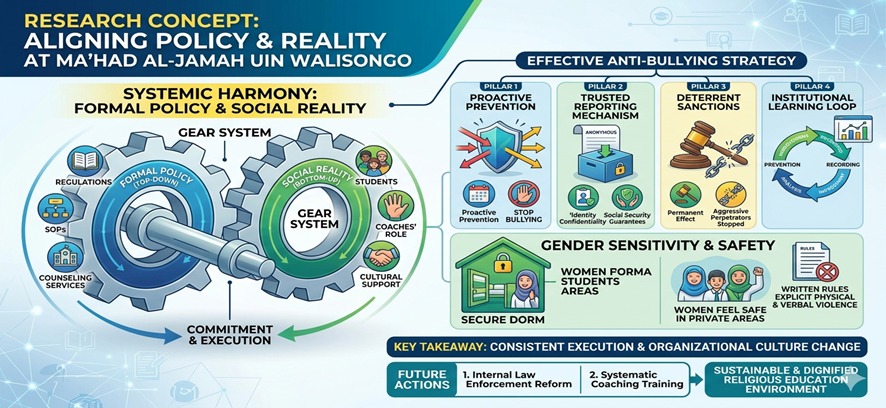
The main objective of this study is to analyze in depth the implementation and effectiveness of anti-bullying strategies for women at Ma'had Al-Jami'ah UIN Walisongo to ensure the psychological safety of female students. Using a qualitative approach with a case study design, empirical data were collected through unstructured interviews, participatory observation, and document analysis at the research location, then analyzed using the Miles and Huberman interactive model. The research findings reveal significant synergy between formal policies and social realities in the field. Strict regulations and case handling Standard Operating Procedures (SOPs) have been implemented consistently, supported by a positive seniority culture normalized in the name of character education and mental mentoring. The role of supervisors appears highly proactive; they function as firm yet inclusive protectors, making the prevention function sharp due to systemic assertiveness. The strategy is deemed effective because it is preventive in nature, the reporting mechanism is trusted by victims due to confidentiality guarantees, and sanctions provide constructive educational effects. The majority of incidents are well-handled, creating a real sense of security for the university's central management. Female students feel safe in private dormitory areas thanks to written rules that are enforced fairly. The prevention cycle continues with meaningful institutional learning. These findings confirm that rules accompanied by consistent execution commitment and a supportive organizational culture are capable of ensuring real protection. Systemic sustainability in internal law enforcement and supervisor training is needed to maintain continuous protection for female students. The contribution of this research lies in uncovering specific institutional integration mechanisms in hybrid religious education that provide a new analytical framework for understanding the success of anti-bullying strategies comprehensively, as well as important policy recommendations for stakeholders.
References
Ariyanta, D. (2024). Implementation of the anti-bullying program in an effort to realize a child-friendly school at State Senior High School 1 Pecangaan Jepara Regency (Doctoral dissertation, Universitas PGRI Semarang).
Aziz, A., & Andriani, T. (2024). The role of teachers in overcoming bullying at SMP Negeri 9, Mojokerto City, East Java. PROGRESSA: Journal of Islamic Religious Instruction, 8(2), 143–151.
Creswell, J. W., & Poth, C. N. (2018). Qualitative inquiry and research design: Choosing among five approaches (4th ed.). Sage Publications.
Denzin, N. K. (2017). The research act: A theoretical introduction to sociological methods (3rd ed.). Routledge. (Original work published 1978)
Faizah, S. N. (2025). Character education management based on religious values. Journal of Education and Contemporary Linguistics, 2(2), 132–138.
Miles, M. B., Huberman, A. M., & Saldaña, J. (2014). Qualitative data analysis: A methods sourcebook (3rd ed.). Sage Publications.
Firnanda, I. A. (2025). Help seeking behavior in victims of sexual violence in higher education (Doctoral dissertation, Maulana Malik Ibrahim State Islamic University).
Frelians, P. P., & Astuti, R. V. (2024). Stigma communication management in single women. Journal of Communication Sciences, 21(1), 57–72.
Gutan, R. L. (2017). Notary responsibility for violation of the code of ethics in making authentic deeds (Case study of MPW decision number W29/T. Pem/Not 03/2010/MPW Notary of Banten Province) (Doctoral dissertation, Islamic University of Indonesia).
Khairunniza, L. D. E., & Supriatna, N. (2025). Analysis of culture dynamics of seniority in the educational environment. Ri'ayah: Journal of Social and Religious Studies, 10(1), 79–92.
Maulida, H. (2021). Women in the study of gender sociology: The construction of social roles, public space, and feminist theory. Journal of Politics and Democracy, 1(1), 71–79.
Namirah, N. (2023). Children's perspective on domestic violence. Harakat an-Nisa: Journal of Gender and Child Studies, 8(2), 99–108.
Normalia, P. (2016). The influence of post-conflict community social conditions on adolescent psychology.
Noviani, N. R. (2024). The effectiveness of the anti-bullying and stop violence declaration program in realizing the vision of Mata Cendeqia (Case study at MI Sunan Pandanaran, Sardonoharjo, Ngaglik, Sleman, Yogyakarta) (Doctoral dissertation, Islamic University of Indonesia).
Rifa'i, Y. (2023). Analysis of qualitative research methodology in data collection in scientific research in the preparation of mini research. Innovative and Cultured Scholars, 1(1), 31–37.
Saripudin, M. H. (2025). Application of institutional theory in public sector organizations in Indonesia: The influence of institutional pressures on internal policy changes. Jupiter: Journal of Management, Accounting, and Economics, 20(8), 21–30.
Sidik, I. A., & Suherman, A. (2024). The effectiveness of the implementation of the law on the protection of women and children in preventing violence. Journal of Legal and Public Policy Studies, 2(1), 174–182.
Sidiki, D. A. A. D., & Damayanti, R. (2025). Protection of women's rights in public administrative policy: Between norms and practices. Bookchapter of Law and Environment, 1, 375–393.
Siregar, M. (2025). The strategy of Islamic religious education teachers in anticipating verbal violence through anti-bullying education at State High School 1 Sibabangun (Doctoral dissertation, UIN Syekh Ali Hasan Ahmad Addary Padangsidimpuan).
Sobarie, N. (2025). Practical guide to child-friendly Islamic boarding school management: Towards a safe and compassionate Islamic boarding school. PT Arr Rad Pratama.
Sugiarto, J. (2025). School without bullying: An integration of academic and practical perspectives. PT Philosophia Anchor Reform.
Sulistyani, A. (2025). The application of scientific writing guidelines as an effort to improve academic quality in higher education. Pendas: Scientific Journal of Basic Education, 10(3), 111–127.
Sumitro, D. S., & Lumintang, M. (2025). Synergy of schools, families, and communities in inclusive, non-violent, and gender-equitable education. Logon Zoes: Journal of Theology, Social, and Culture, 8(2), 12–25.
Tilung, F. (2023). Collaborative governance of handling victims of violence against women and children through the Safe House of the Ministry of Women's Empowerment and Child Protection (Doctoral dissertation, Polytechnic STIA LAN Jakarta).
Downloads
Published
How to Cite
Issue
Section
License
Copyright (c) 2026 Journal of Islamic Education Thought and Development

This work is licensed under a Creative Commons Attribution-ShareAlike 4.0 International License.
Copyright Notice
Authors who publish in the Journal of Islamic Education Thought and Development agree to the following terms:
- Copyright Ownership
Authors retain the copyright of their published work and grant the Journal of Islamic Education Thought and Development the right of first publication. - Creative Commons License
The published work is simultaneously licensed under the Creative Commons Attribution 4.0 International License (CC BY 4.0), which permits others to copy, distribute, adapt, and build upon the work, provided appropriate credit is given to the original author(s) and the journal as the initial publisher. - Additional Distribution Rights
Authors may enter into separate, additional contractual arrangements for the non-exclusive distribution of the published version of the work, such as depositing it in an institutional repository, publishing it in a book, or sharing it through other academic platforms, provided that acknowledgment is made of its initial publication in the Journal of Islamic Education Thought and Development. - Self-Archiving Policy
Authors are permitted and encouraged to post their manuscripts online, including in institutional repositories, personal websites, or academic networking platforms, both before and during the submission process. - Benefits of Early Dissemination
Early online dissemination of research may facilitate scholarly exchange, increase visibility, and contribute to earlier and broader citation of published articles.