School Dropout and Adaptive Resilience: Understanding Adolescents’ Educational Choices in Muslim Marginalized Communities
DOI:
https://doi.org/10.67046/jietd.v1i2.75Keywords:
dropout, adaptive resilience; human capital, Islamic marginalized communitiesAbstract
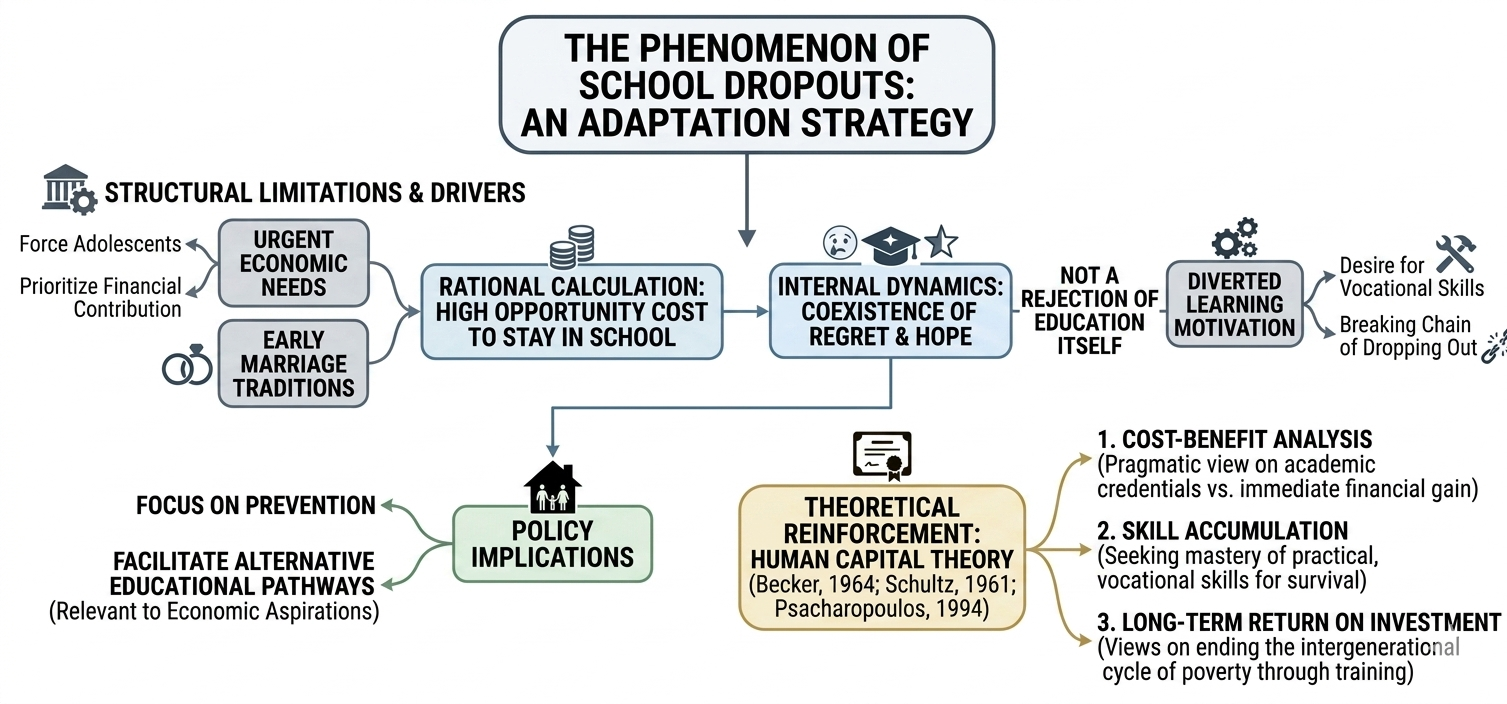
This study aims to uncover the meaning behind the phenomenon of school dropout among adolescents in Islamic marginalized communities, Lamongan City, Indonesia. This phenomenon is often negatively stigmatized as academic failure alone without understanding the underlying context. Using a qualitative approach with an in-depth case study design, data were collected through unstructured interviews, participant observation, and analysis of village archive documents, then systematically analyzed using the Miles and Huberman interactive model. Data validity was ensured through rigorous source triangulation. The results indicate that school dropout in this region is a manifestation of the tension between immediate economic needs and the long-term value of education. Economic factors and the tradition of early marriage force adolescents to adopt a pragmatic view that prioritizes immediate family financial contributions over continuing formal schooling. However, crucial findings reveal the presence of regret and hope in breaking the cycle of poverty, indicating that motivation to learn is not lost but rather shifted to mastering vocational skills as a means of survival. This dynamic confirms that the decision to drop out of school is not a rejection of education itself, but rather a rational adaptation strategy to environmental conditions that require facilitative policy interventions in the form of alternative educational pathways. This research contributes to the development of Islamic education by emphasizing the need for inclusive, community-based, and value-oriented educational models that integrate social resilience, vocational empowerment, and humanistic Islamic principles in addressing school dropout among marginalized adolescents
References
Ainuri, A. F. Y., Waeduereh, M., Alfaizi, F. F., Rahmah, F. A., & Zahro, F. F. (2026). Religious Moderation as a Strategy to Counter Radicalization: A Study of Islamic Education Students at Indonesia Higher Education. Journal of Islamic Education Thought and Development, 1(2), 15-30.
Akhmadi. (2021). The relevance of curriculum to the living needs of poor students: A study on learning motivation in disadvantaged areas. Indonesian Journal of Education, 10(2), 45–67.
Amelia, R. A., Easy, S. R., Giofika, S., Fathuloh, R. H., Putri, R. M., Putri, S. R., & Khairat, A. (2025). Optimizing the Role of Teachers and Educators in Realizing Quality Character-Based Education in the Digital Age. Social Journal of Studies in Education, 1(02), 11-20.
Bappenas. (2020). National medium-term development plan 2020–2024: Improving the quality of human resources. Ministry of National Development Planning/Bappenas.
Becker, G. S. (1964). Human capital: A theoretical and empirical analysis, with special reference to education. Columbia University Press.
Constitution of the Republic of Indonesia. (1945). The 1945 Constitution of the Republic of Indonesia.
Research Design: Qualitative, Quantitative, and Mixed Methods Approaches
Creswell, J. W. (2014). Research design: Qualitative, quantitative, and mixed methods approaches (4th ed.). Sage Publications.
Fadjar, A. M. (2005). The new paradigm of national education: Reconstruction and democratization. PT Rineka Cipta.
Hasan, K., Ayinla, Y. S., Sabirah, S., & Tawakalitu, Y. B. (2026). Use of Mindfulness-Based Intervention in Reducing Test Anxiety among Students in Tertiary Institutions. Journal of Islamic Education Thought and Development, 1(2), 1-14.
Law of the Republic of Indonesia Number 20 of 2003 concerning the National Education System. (2003). State Gazette of the Republic of Indonesia Year 2003 No. 78. State Secretariat.
Lincoln, Y. S., & Guba, E. G. (1985). Naturalistic inquiry. Sage Publications.
Ministry of Education and Culture. (2023). Basic education data: School dropout statistics of disadvantaged regions after the economic crisis. Ministry of Education, Culture, Research, and Technology.
Miles, M. B., & Huberman, A. M. (1994). Qualitative data analysis: An expanded sourcebook (2nd ed.). Sage Publications.
Moleong, L. J. (2017). Qualitative research methodology (Revised ed.). PT Remaja Rosdakarya.
Psacharopoulos, G. (1994). Returns to investment in education: A global update. World Development, 22(9), 1325–1343.
Schultz, T. W. (1961). Investment in human capital. The American Economic Review, 51(1), 1–17.
Spradley, J. P. (1979). The ethnographic interview. Holt, Rinehart and Winston.
Stake, R. E. (1995). The art of case study research. Sage Publications.
Suryadarma, D. (2020). Parent education and sustainability of children's schools in rural Indonesia. Journal of Economics and Education, 17(1), 23–41.
Susilo, H. (2019). Rural community empowerment strategy in overcoming structural poverty. Student Library.
Tilaar, H. A. R. (2000). The new paradigm of national education: Analysis and reflection. PT Rineka Cipta.
Tilaar, H. A. R. (2002). Education, culture, and Indonesian civil society: A national education reform strategy. PT Remaja Rosdakarya.
UNESCO. (2021). Global education monitoring report: Non-state actors in education. UNESCO Publishing.
World Bank. (2022). Indonesia economic prospects: Strengthening education for recovery and growth. World Bank Publications.
Downloads
Published
How to Cite
Issue
Section
License
Copyright (c) 2026 The Author (S).

This work is licensed under a Creative Commons Attribution-ShareAlike 4.0 International License.
Copyright Notice
Authors who publish in the Journal of Islamic Education Thought and Development agree to the following terms:
- Copyright Ownership
Authors retain the copyright of their published work and grant the Journal of Islamic Education Thought and Development the right of first publication. - Creative Commons License
The published work is simultaneously licensed under the Creative Commons Attribution 4.0 International License (CC BY 4.0), which permits others to copy, distribute, adapt, and build upon the work, provided appropriate credit is given to the original author(s) and the journal as the initial publisher. - Additional Distribution Rights
Authors may enter into separate, additional contractual arrangements for the non-exclusive distribution of the published version of the work, such as depositing it in an institutional repository, publishing it in a book, or sharing it through other academic platforms, provided that acknowledgment is made of its initial publication in the Journal of Islamic Education Thought and Development. - Self-Archiving Policy
Authors are permitted and encouraged to post their manuscripts online, including in institutional repositories, personal websites, or academic networking platforms, both before and during the submission process. - Benefits of Early Dissemination
Early online dissemination of research may facilitate scholarly exchange, increase visibility, and contribute to earlier and broader citation of published articles.