School Infrastructure Inequality and the Reproduction of Educational Disadvantage: A Bourdieusian Analysis of Cultural Capital Formation in Marginalized Regions
DOI:
https://doi.org/10.67046/jietd.v2i01.77Keywords:
education gap, school infrastructure, social reproduction theory, cultural capitalAbstract
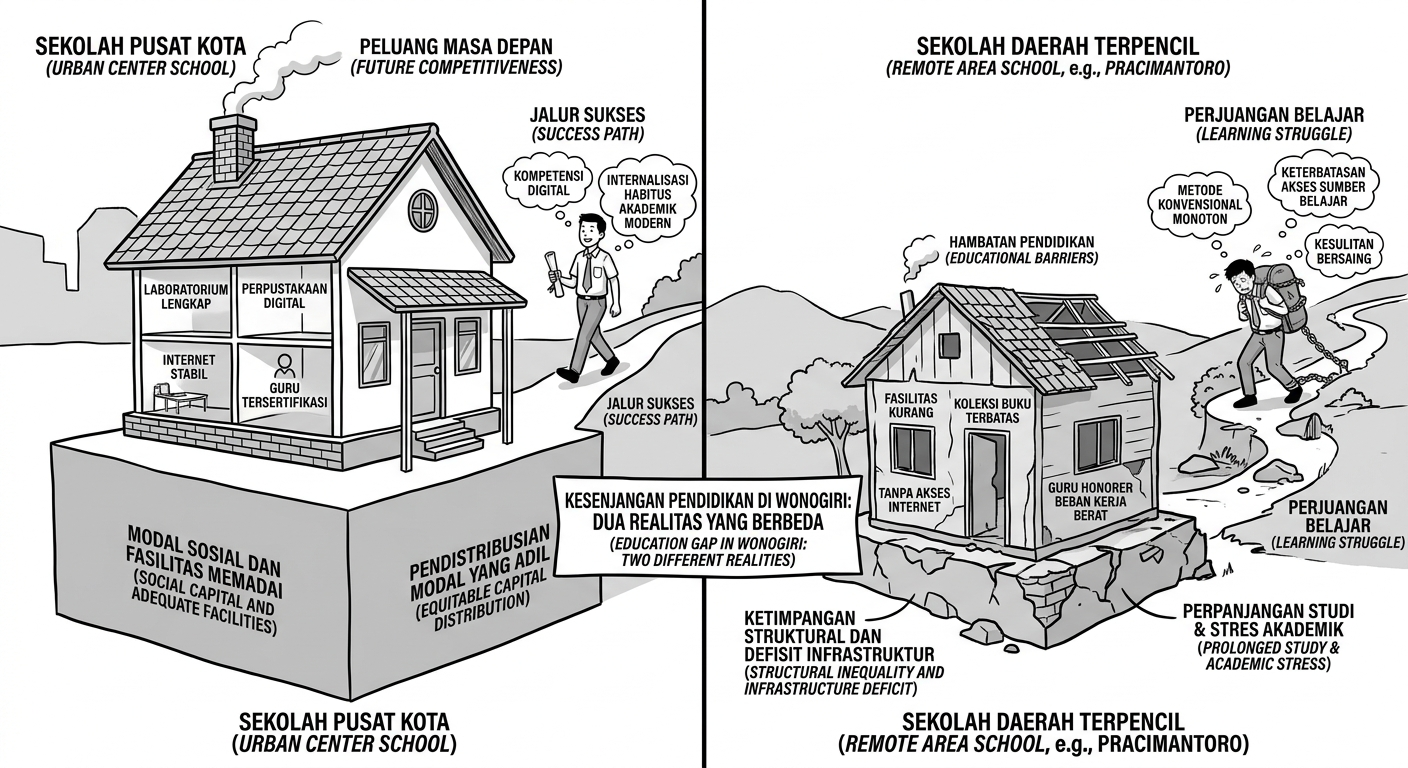
Educational inequality remains a persistent challenge in disadvantaged regions, where disparities in school infrastructure continue to shape unequal learning opportunities and educational outcomes. This study investigates how infrastructural inequalities contribute to the reproduction of educational disadvantage among senior high school students in Wonogiri, Indonesia, through the lens of Pierre Bourdieu’s Social Reproduction Theory. Employing a qualitative case study design, data were collected through in-depth interviews, participant observation, and document analysis involving students, teachers, school leaders, and local education stakeholders. Data were analyzed using the Miles and Huberman interactive framework to identify patterns linking material conditions to educational experiences and outcomes. The findings reveal that unequal access to educational infrastructure—including laboratories, libraries, digital technologies, and internet connectivity—creates significant disparities in students’ opportunities to acquire cultural capital. Students in rural and geographically marginalized schools experience limited exposure to academic practices, digital competencies, and skill-development opportunities compared with their counterparts in better-resourced schools. These disparities constrain educational achievement and reduce students’ capacity to compete in higher education and labor markets. The study demonstrates that infrastructural inequality functions not merely as a resource deficit but as a structural mechanism through which educational disadvantage is reproduced across generations. This research extends Bourdieu’s framework by highlighting the mediating role of school infrastructure in the conversion of economic capital into cultural capital within disadvantaged educational settings. The findings suggest that equitable infrastructure investment is essential for disrupting cycles of educational inequality and promoting inclusive human capital development. Consequently, policies aimed at reducing regional disparities must prioritize the redistribution of educational resources to ensure more equitable learning opportunities and social mobility.
References
Aderempas, T., Lukman, A., & Emmi, K. H. (2025). Implementasi Kebijakan Pemerintah Daerah Bidang Pendidikan Dan Implikasinya Terhadap Pemerataan Infrastruktur Pendidikan Di Kabupaten Kepahiang (Doctoral dissertation, Institut Agama Islam Negeri Curup).
Azkiyah, S. R., Aryola, G., & Lukitoaji, B. D. (2025). Isu kesenjangan pendidikan di daerah terpencil: Solusi untuk mewujudkan pendidikan yang merata. Sosiola Pedagogi: Jurnal Inovasi Pendidikan, Sosial, dan Humaniora, 1(1).
Calista, C. P., Putra, F. A. I., Maulita, F., Zahra, M., & Syakirah, N. A. (2025). Kesenjangan pendidikan antara wilayah pedesaan dan perkotaan: analisis kebijakan dan praktik di indonesia. Integrative Perspectives of Social and Science Journal, 2(03 Juni), 3965-3978
Dharmayanti, W., Nurcahyo, R. W., & Lestari, I. (2017). Pengaruh kondisi kelas, fasilitas laboratorium, dan fasilitas pendukung pembelajaran terhadap kenyamanan belajar mahasiswa. Jurnal Pendidikan Informatika dan Sains, 6(2), 230-242.
Fitriyani, H., Umayyah, S., Fatin, N. F., & Fatayan, A. (2025). Pengaruh Stratifikasi Sosial Terhadap Akses Pendidikan Dasar di Wilayah Perkotaan dan Pedesaan. Journal Sains Student Research, 3(4), 34-44.
Gamaputra, G., Alrianingrum, S., & El Rizaq, A. D. B. (2025). Ekspansi Pendidikan Tinggi: Harapan, Tantangan, dan Peluang Transformasi Sosial. Penerbit: Kramantara JS.
Hendrik Dewantara, S. E. (2024). Membangun masa depan pendidikan: Inovasi dan tantangan dalam sertifikasi guru di Indonesia. PT Indonesia Delapan Kreasi Nusa.
Karoluslina, K., Mappanyompa, M., Puspitarini, H., Muhirdan, M., Arianto, T., Rahmi, S., ... & Nurjannah, D. R. (2026). Pendidikan Indonesia Menuju Masa Depan. Yayasan Tri Edukasi Ilmiah.
Lumbu, A., Panda, F. M., Judijanto, L., Djollong, A. F., Tumober, R. T., Priyanto, P., ... & Ardiansyah, W. (2026). Metode Penelitian Kualitatif: Teori dan Penerapan Praktis Analisis Data Berbasis Studi Kasus. PT. Sonpedia Publishing Indonesia.
Malik, R., Susanti, R., Hidir, A., Ihsan, M., & Dzulqarnain, M. F. (2025). Triangulasi dan analisis domain; Meningkatkan kredibilitas dan kedalaman penelitian kualitatif. KAMBOTI: Jurnal Sosial dan Humaniora, 6(1), 33-41.
Muiz, A., Anisah, R., Khoiruddin, U., & Indrioko, E. (2024). Kebijakan pendidikan dalam mengatasi masalah kualitas, kuantitas efektivitas dan efisiensi. IHSAN: Jurnal Pendidikan Islam, 2(3), 46-64.
Muttaqin, M. F., Ahsani, E. L. F., & Wijayama, B. (2025). Problematika Pendidikan Di Indonesia: Tantangan Dan Solusi (Mengupas Aspek Sosial, Ekonomi, dan Karakter dalam Pendidikan). Cahya Ghani Recovery.
Nelliraharti, N., & Jarmita, N. (2025). Pengelolaan sarana dan prasarana pendidikan dalam meningkatkan kualitas pembelajaran. Journal of Education Science, 11(1), 35-43.
NUSANTARA, D. P., & SUSANTI, R. (2017). FAKTOR-FAKTOR YANG MEMPENGARUHI PEMILIHAN FASILITAS PENDIDIKAN PADA MASYARAKAT PINGGIRAN KOTA SEMARANG (STUDI KASUS: KECAMATAN MRANGGEN, KABUPATEN DEMAK) (Doctoral dissertation, UNIVERSITAS DIPONEGORO).
Prihatin, E., Kadarsah, D., & IZFS, R. D. (2025). Kebijakan Pendidikan Nasional: Transformasi Digital untuk Sistem yang Inklusif. Indonesia Emas Group.
Radianto, W. E. D., Murwani, F. D., Wono, H. Y., Kom, S. I., & Kom, M. M. (2025). Metode Penelitian Studi Kasus. Prenada Media.
Rusli, A., Fadhil, M., Ishaq, M., Hidayatullah, R., & Harmonedi, H. (2025). Strategi Pengumpulan dan Pengelolaan Data dalam Penelitian Pendidikan: Kajian Teoretis dan Praktis. IHSAN: Jurnal Pendidikan Islam, 3(3), 573-581.
Sari, T. N. (2025). MEMBANGUN PENDIDIKAN BERKEADILAN: MENGATASI MASALAH PEMERATAAN PENDIDIKAN ANTARA DAERAH DAN PERKOTAAN. Jurnal Pendidikan Indonesia, 6(4).
Satria, D., Kusasih, I. H., & Gusmaneli, G. (2025). Analisis rendahnya kualitas pendidikan di Indonesia saat ini: Suatu kajian literatur. Jurnal Bintang Pendidikan Indonesia, 3(2), 292-309.
Siahay, M. C., Ahmad, S. N., Gusty, S., Supacua, H. A. I., Ampangallo, B. A., Rachman, R. M., ... & Maitimu, A. (2023). Pembangunan infrastruktur di Indonesia. Tohar Media.
Sumar, W. T., & Prasetijo, Z. J. D. (2024). Kebijakan Pemerintah Daerah Dalam Pembiayaan Pendidikan. Deepublish.
Ulfatin, N. (2022). Metode penelitian kualitatif di bidang pendidikan: Teori dan Aplikasinya. Media Nusa Creative (MNC Publishing).
Ulumudin, M. M., Fauzi, N. A. K., & Zakiyah, I. (2025). Pengantar Inovasi dalam Pengelolaan Pendidikan. PT Arr Rad Pratam.
Vito, B., Krisnani, H., & Resnawaty, R. (2016). Kesenjangan pendidikan desa dan kota. Prosiding KS, 2(2).
Downloads
Published
How to Cite
Issue
Section
License
Copyright (c) 2026 Muhamad Rayhan Al-Arif, Choirunnajih Hadanil Alqo, Muhamad Aufa Ulinnuha, Muhammad Mu’allimin Al-Musyafa, Muhammad Imran Musthofa

This work is licensed under a Creative Commons Attribution-ShareAlike 4.0 International License.
Copyright Notice
Authors who publish in the Journal of Islamic Education Thought and Development agree to the following terms:
- Copyright Ownership
Authors retain the copyright of their published work and grant the Journal of Islamic Education Thought and Development the right of first publication. - Creative Commons License
The published work is simultaneously licensed under the Creative Commons Attribution 4.0 International License (CC BY 4.0), which permits others to copy, distribute, adapt, and build upon the work, provided appropriate credit is given to the original author(s) and the journal as the initial publisher. - Additional Distribution Rights
Authors may enter into separate, additional contractual arrangements for the non-exclusive distribution of the published version of the work, such as depositing it in an institutional repository, publishing it in a book, or sharing it through other academic platforms, provided that acknowledgment is made of its initial publication in the Journal of Islamic Education Thought and Development. - Self-Archiving Policy
Authors are permitted and encouraged to post their manuscripts online, including in institutional repositories, personal websites, or academic networking platforms, both before and during the submission process. - Benefits of Early Dissemination
Early online dissemination of research may facilitate scholarly exchange, increase visibility, and contribute to earlier and broader citation of published articles.