Islamic Higher Education as Moral Safeguarding
Religious Motivations among Coastal Communities in Indonesia
DOI:
https://doi.org/10.67046/jietd.v1i2.79Keywords:
Islamic higher education, moral safeguarding, coastal communities, religious motivationAbstract
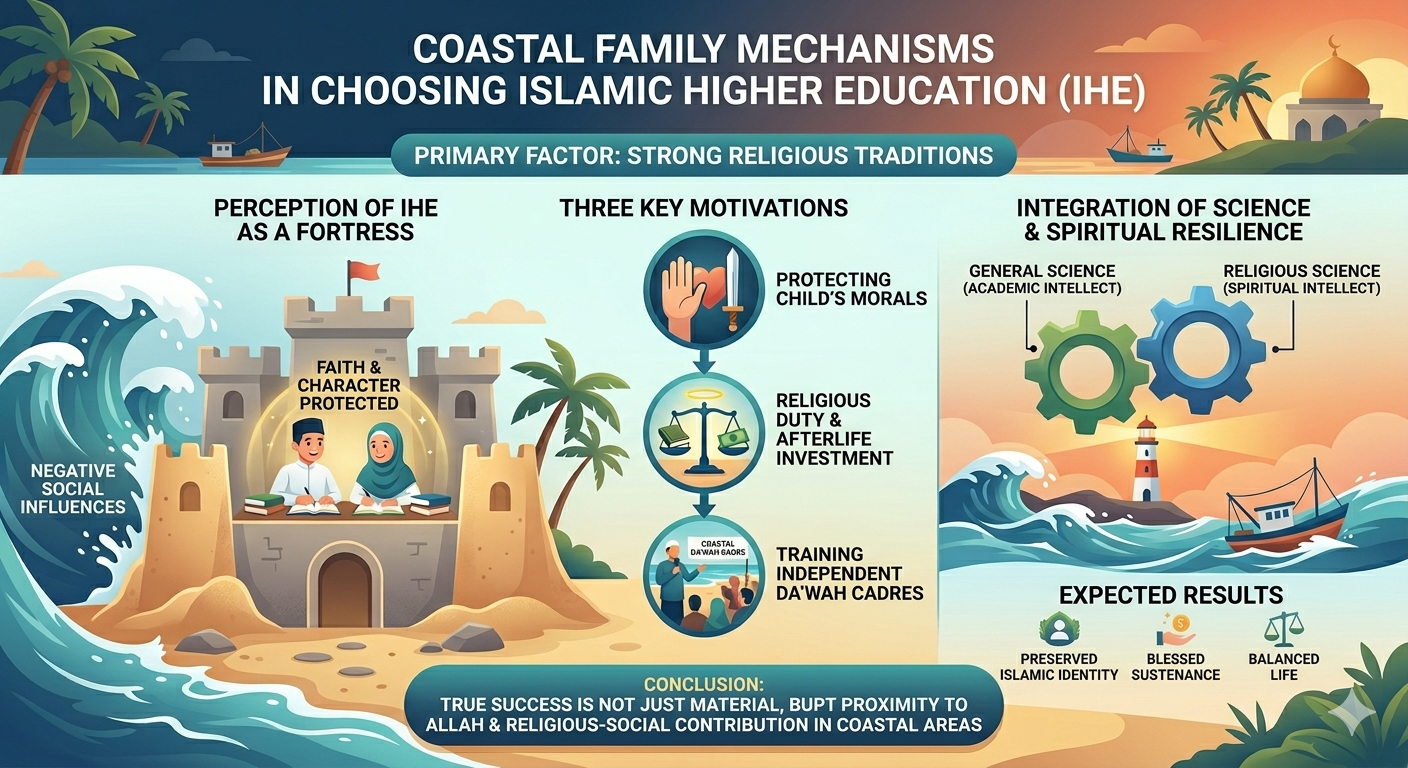
This study aims to explore the religious motivations of coastal communities in Indonesia in choosing Islamic Higher Education Institutions (PTI) as a moral and spiritual bulwark for their children. The study used a qualitative approach with a case study design to understand the religious, social, and cultural considerations underlying coastal communities' educational choice of PTI. Data were collected through in-depth interviews, observations, and documentation involving parents, religious leaders, and coastal communities. The research findings indicate that strong religious traditions are a major factor influencing coastal families in choosing PTI. Parents view PTI not only as an academic educational institution, but also as a moral and spiritual bulwark capable of maintaining their children's faith, character, and behavior amidst the exposed coastal environment that is vulnerable to negative social influences. This educational choice is driven by three main motivations: protecting children's morality, fulfilling religious obligations in pursuing Islamic knowledge as an investment for this world and the hereafter, and preparing future da'wah cadres capable of independently meeting the spiritual needs of coastal communities. Furthermore, the community believes that the integration of religious and general knowledge at PTI can produce graduates who are intellectually competent and spiritually resilient in facing the uncertainties of fishing life. Islamic boarding schools (PTI) are also seen as a means of maintaining the family's Islamic identity, gaining blessings of sustenance, and achieving a balance between worldly success and eternal happiness. Thus, this study demonstrates that coastal communities' decisions to choose Islamic boarding schools (PTI) are not solely based on academic considerations, but also on the need for moral protection, strengthening religious identity, and sustaining Islamic values in the lives of coastal communities. This research contributes to expanding the study of the sociology of Islamic education by positioning Islamic boarding schools (PTI) as a strategic institution in maintaining the moral and spiritual resilience of coastal Muslim communities in contemporary Indonesia.
References
Adiele, E. E., & Abraham, N. (2013). Achievement of Abraham Maslow's needs hierarchy theory among teachers: Implications for human resource management in the secondary school system in Rivers State. Journal of Curriculum and Teaching, 2(1), 140–144.
Ali, M. (2020). Islamic education and social change. Discourse Library.
Amaliyah, E. L. (2022). Inculcation of the educational values of Islamic beliefs in people in Bandari Hamlet, Wedung Village, Wedung District, Demak Regency.
Arafah, W., Tawakal, A., Mz, M. D., & Saluy, A. B. (2025). Strategy coastal economic development for community empowerment. Berseri.
Azizi, N. D., Albab, A. W., & Chotimah, C. (2026). Contextual Teaching and Learning (CTL) Model to Improve Reading and Writing Literacy Skills of Elementary School Students. Social Journal of Studies in Education, 2(01), 31-46.
Belardo, S. B., & Candelaria, A. P. (2023). Aspirations of fisherfolk communities on their children’s education in Albay, Asid, and Ragay Gulfs of Bicol, Philippines. Journal of Geoscience and Environment Protection, 11(7), 136–155.
Fauzian, R., & Istianah, R. (2025). Islamic education and the challenges of the globalization era: Dynamics economic, social, cultural, political, and policy reorientation. CV. Library Intake.
Gamaputra, G., Alrianingrum, S., & El Rizaq, A. D. B. (2025). Expansion higher education: Hopes, challenges, and opportunities for social transformation. Kramantara JS.
Handoko, Y., Wijaya, H. A., & Lestari, A. (2024). Qualitative research methods guide practical for educational administration research. PT. Sonpedia Publishing Indonesia.
Hidayanti, M., Masudi, M., & Putra, H. P. (2024). Parents' interest in going to school children at the Al-Ashriyyah Nurul Islam Islamic Boarding School, Padang City Village, Semende Darat Tengah District, Muara Enim Regency.
Inayah, A., Saputra, S. A., & Nasirudin, N. (2026). Deferred aspirations and structural poverty: Psychological-spiritual barriers and community-based empowerment in Islamic education among rural youth in Indonesia. Journal of Islamic Education Thought and Development, 1(2), 83–98.
Junaedi, E., Ulum, R., & Putro, M. Z. A. E. (2018). DA'wah based on mosques in Indonesia. ICECRD Center for Religious Guidance and Services, Agency for Research and Development and Training of the Ministry of Religion.
Lacey, A., & Luff, D. (2001). Qualitative data analysis (pp. 320-357). UK: Trent Focus Group.
Miles, M. B., Huberman, A. M., & Saldana, J. (2014). Qualitative data analysis. sage.
Nadia, H., Mawardi, M., Putri, E. E., & Hidayat, H. (2025). The value paradox religious: A critical analysis of the effectiveness of Islamic religious education in overcoming the phenomenon of bullying in Jambi provincial educational institutions. NUR EL-ISLAM: Journal of Religious Education and Social Affairs, 12(2), 45–62.
Osagiobare, O. E., Oronsaye, R. O., & Ekwukoma, V. (2015). Influence of religious and cultural beliefs on girl-child educational aspiration in Nigeria. Journal of Educational and Social Research, 5, 165.
Parfitt, A., & Read, S. (2023). Educator views regarding young people’s aspirations in peripheral coastal communities in England: A Q study. Oxford Review of Education, 49(6), 764–780.
Poston, B. (2009). Maslow’s hierarchy of needs. The Surgical Technologist, 41(8), 347–353.
Qonitatun, A., Mustopa, M., Rohmah, A. R. K. A., Luwistiana, S. N., Yuniasih, Z. K., & Zhagypar, A. (2026). Anti-bullying strategies in pesantren affiliated with universities: A case study of women’s protection policies at Ma’had Al-Jami’ah Walisongo. Journal of Islamic Education Thought and Development, 1(2), 58–80.
Rambe, M. S., Fadhilah, F., Amanda, B., et al. (2024). The important role of education religious to the future of the child. Innovative: Journal of Social Science Research, 4(1), 13079–13087.
Ramli, S., Fadhila, G., Husmen, R., & Darmawan, A. (2026). Integrating Maqashid Shari’a on Cultural Responsiveneness to Constructing Academic Culture. Social Journal of Studies in Education, 2(01), 1-15.
Ramli, S., Fadhila, G., Husmen, R., & Darmawan, A. (2026). Integrating Maqashid Shari’a on Cultural Responsiveneness to Constructing Academic Culture. Social Journal of Studies in Education, 2(01), 1-15.
Sarmauli, M. T., Marbun, T. O., et al. (2024). Anthropological theological studies of eating sapa in the Toba Batak tradition in Samosir Regency and its implications to interreligious communication. CV Publisher SARNU UNTUNG.
Sasono, A. (1998). Islamic solutions to the problems of the ummah: Economy, education, and da'wah. Echo Insani.
Sgier, L. (2012). Qualitative data analysis. An Initiat. Gebert Ruf Stift, 19, 19-21.
Simons, J. A., Irwin, D. B., & Drinnien, B. A. (1987). Maslow’s hierarchy of needs. Retrieved October 9, 2009, from http://www.ship.edu
Solehuddin, M. S. (2026). Secularism and Its Challenges to Islamic Education: A Historical and Philosophical Analysis of Islamic Education. Social Journal of Studies in Education, 2(01), 64-78.
Syarif, M. Z. H. (2020). Religion and social change: The significance of Islamic education as a stabilizer of life. Publica Institute Jakarta.
Talaohu, A. R., & Faisal, R. (2025). Coastal community empowerment model (Case study in Laha Country, Ambon Bay, Baguala, Ambon City). Journal of Social and Science, 5(11), 7824–7837.
Wada, F. H., Pertiwi, A., Hasiolan, M. I. S., et al. (2024). Textbooks research methodology. PT. Sonpedia Publishing Indonesia.
Wahyuni, R. (2025). The role of parents in fostering children's morals in Kembang Mumpo Village, Semidang Alas Maras District, Selamba Regency.
Waliyurrahim, M. (2022). Multicultural Islamic education at Karya Pembangunan Islamic Boarding School Manado City, North Sulawesi Province.
Downloads
Published
How to Cite
Issue
Section
License
Copyright (c) 2026 The Author (S).

This work is licensed under a Creative Commons Attribution-ShareAlike 4.0 International License.
Copyright Notice
Authors who publish in the Journal of Islamic Education Thought and Development agree to the following terms:
- Copyright Ownership
Authors retain the copyright of their published work and grant the Journal of Islamic Education Thought and Development the right of first publication. - Creative Commons License
The published work is simultaneously licensed under the Creative Commons Attribution 4.0 International License (CC BY 4.0), which permits others to copy, distribute, adapt, and build upon the work, provided appropriate credit is given to the original author(s) and the journal as the initial publisher. - Additional Distribution Rights
Authors may enter into separate, additional contractual arrangements for the non-exclusive distribution of the published version of the work, such as depositing it in an institutional repository, publishing it in a book, or sharing it through other academic platforms, provided that acknowledgment is made of its initial publication in the Journal of Islamic Education Thought and Development. - Self-Archiving Policy
Authors are permitted and encouraged to post their manuscripts online, including in institutional repositories, personal websites, or academic networking platforms, both before and during the submission process. - Benefits of Early Dissemination
Early online dissemination of research may facilitate scholarly exchange, increase visibility, and contribute to earlier and broader citation of published articles.