Student Obedience and Spiritual Well-Being in Islamic Education: Exploring the Role of Adab in Teacher–Student Relationships
DOI:
https://doi.org/10.67046/jietd.v2i01.81Keywords:
student compliance, inner satisfaction, islamic educationAbstract
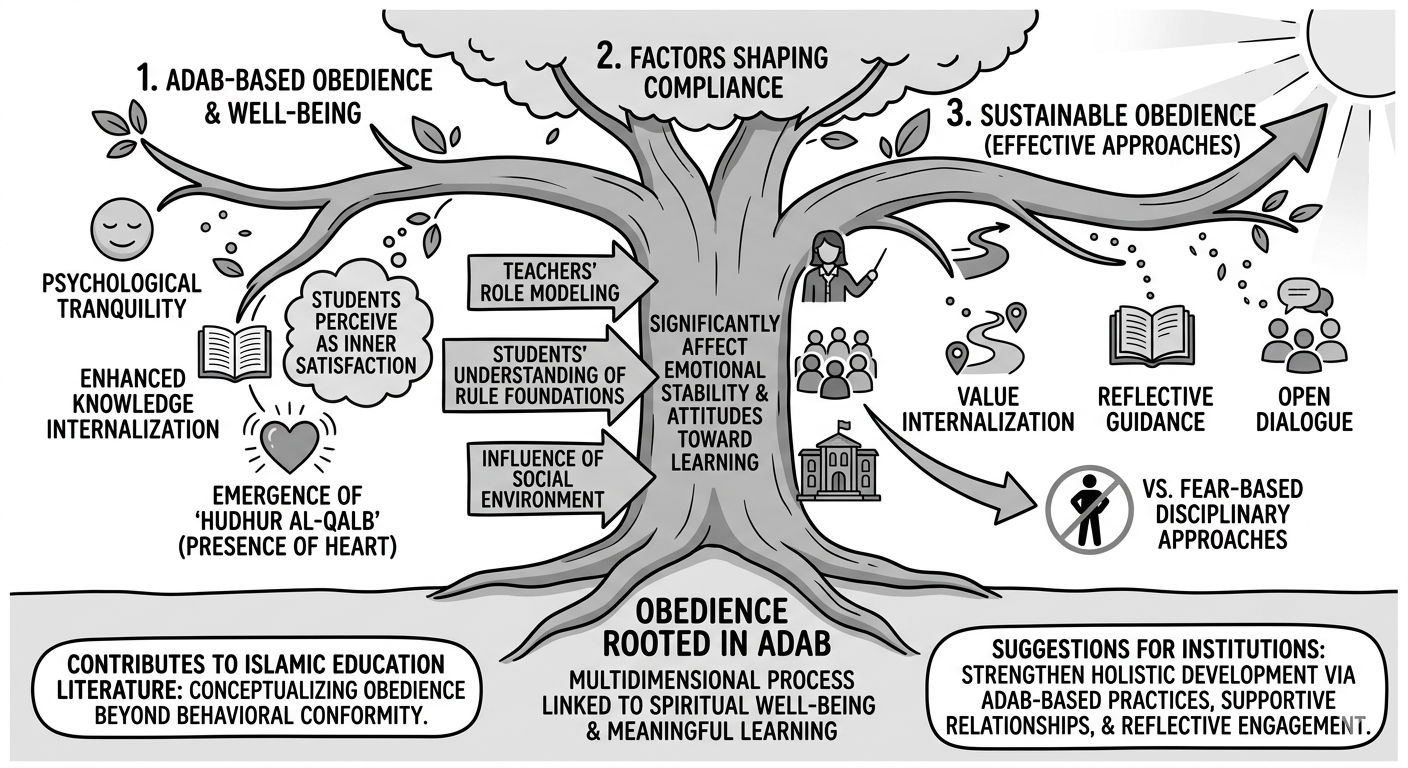
This study investigates the relationship between student obedience to teachers and students’ inner satisfaction within the context of Islamic boarding school education. Despite extensive discussions on teacher–student relationships in Islamic education, limited research has explored how obedience grounded in adab (ethical conduct) contributes to students’ spiritual well-being and learning experiences. Employing a qualitative case study design, this research involved eight students selected through purposive sampling. Data were collected through in-depth interviews, participatory observation, and document analysis and were analyzed using the Miles and Huberman interactive model. The findings reveal three major themes. First, obedience rooted in adab is associated with psychological tranquility, enhanced knowledge internalization, and the emergence of hudhur al-qalb (presence of heart), which students perceive as a form of inner satisfaction during the learning process. Second, students’ compliance is shaped by multiple factors, including teachers’ role modeling, students’ understanding of the philosophical foundations of institutional rules, and the influence of the surrounding social environment. These factors significantly affect students’ emotional stability and attitudes toward learning. Third, sustainable obedience is more effectively fostered through value internalization, reflective guidance, and open dialogue than through fear-based disciplinary approaches. This study contributes to the literature on Islamic education by conceptualizing obedience not merely as behavioral conformity but as a multidimensional process linked to spiritual well-being and meaningful learning. The findings suggest that educational institutions can strengthen students’ holistic development by promoting adab-based educational practices that integrate moral formation, supportive teacher–student relationships, and reflective engagement with institutional norms.
References
Abshar, U. (2025). The psychological well-being of students in the perspective of culture and indigenous psychology. Al Irfan: Journal of Education and Research, 1(2), 139–144.
Akbar, F. M. A. (2024). Qualitative and Quantitative Methods in Islamic Studies. Ar Rasyiid: Journal of Islamic Studies, 2(2), 95–112.
Al-kaff, A. M., Sutrisno, S., & Suwadi, S. (2026). Socialization of Positive Discipline in the Child-Friendly Islamic Boarding School Program on the Mental Health of Students. SIGMA: Journal of Synergy of Service, 3(2), 88–95.
ALMA, A. (2025). IMPLICATIONS OF KIAI AND SANTRI RELATIONSHIP PATTERNS AND THEIR INFLUENCE ON CHANGES IN STUDENT BEHAVIOR (Study at Al Falah Islamic Boarding School, Sidomulyo Village, Pagar Dewa District, West Lampung Regency) (Doctoral dissertation, UIN Raden Intan Lampung).
Amrullah, A. (2023). Islamic Education: Building a Superior Generation in a Holistic Education Policy Framework. Scholastica: Journal of Education and Culture, 5(1), 74–86.
Anami, M. H. (2021). Ma'had Curriculum Management in Improving the Character of Students at Ma'had Ronggo Warsito Man 2 Ponorogo. IAIN Ponorogo.
Aula Ramadhani, T., Azwar, B., & Nurjanah, N. (2025). The concept of the Prophet's educational pattern as a model of character education in Indonesia. Curup State Islamic Religious Institute.
Gainau, M. B. PSYCHOLOGY IN EDUCATION (Building Resilience and Student Learning Achievement)-Literature Trail. Trail of Literature.
Fitrah, M. (2018). Research methodology: qualitative research, classroom action & case studies. Publisher Footprint CV.
Hakim, A. M. (2012). Ulumul Qur'an (2nd ed.). Al Huda Publishers.
Hamka, M., Handrianto, B., & Agusman, A. (2024). Adab sebagai Jembatan antara Ilmu dan Amal dalam Pembentukan Karakter Siswa: Adab as a Bridge between Knowledge and Deeds in Shaping Students’ Character. TARBIYAH: Journal of Education and Learning, 1(2), 132–142.
Hasan, K., Ayinla, Y. S., Sabirah, S., & Tawakalitu, Y. B. (2026). The Use of Mindfulness-Based Interventions in Reducing Test Anxiety Among Students in Nigerian Higher Education. Journal of Islamic Education Thought and Development, 1(2), 1-14.
Irfieh, F., Madaniah, L. H., & Sanusi, H. P. (2026). Qualitative Analysis of Organizational Culture and Its Implications for Educator Performance in a Positive Organizational Psychology Perspective. JISMA: Journal of Social Sciences, Management, and Accounting, 4(1), 1657-1680.
Ihsan, H., Khafidin, H. Z., Zuhri, A., & Annas, A. (2025). Islamic Boarding School Moderation Education Model: Implementation of Walisongo Da'wah Teaching Practices & Strategies. Diwan Media Pustaka.
Istianah, I., & Azizah, A. N. (2025). Educational Strategies (Ethics, Discipline, Ukhuwah, Character, and Islamic Synergy) in Increasing Student Compliance with Teachers at Diniyah Takmiliyah. TREND-MESSAGE: Journal of Islamic Boarding Schools and Madrasas, 4(1), 163–184.
Luailik, M. (2024). The Influence of School Wellbeing on Students' Compliance in Obeying Rules with Social Support as a Mediator: A Study on Students of Bayt Al-Hikmah Pasuruan Islamic Boarding School. Maulana Malik Ibrahim State Islamic University.
Lutfiyah, N., Shanie, A., Muhajirin, M., Damayanti, L., Fatah, N. A., & Fatikah, E. Y. U. (2025). The Effect of Academic Stress on Students' Psychological Well-Being in the Context of Islamic Education. Journal of Teacher Training and Education (JKIP), 3(4), 125–132.
Malik, R., Susanti, R., Hidir, A., Ihsan, M., & Dzulqarnain, M. F. (2025). Domain triangulation and analysis; Increase the credibility and depth of qualitative research. KAMBOTI: Journal of Social and Humanities, 6(1), 33–41.
Mukminin, Y. Z. A. (2018). The Influence of Moral Education on Students' Compliance with School Rules at MAN 3 Sleman Yogyakarta.
Mulyana, A., Vidiati, C., Danarahmanto, P. A., Agussalim, A., Apriani, W., Fiansi, F., ... & Martono, S. M. (2024). Qualitative research methods. Widina Publisher.
Pattipeiluhu, K., Yuslainiwati, S. H., Novaria, I. E., & Herdiani, R. (2026). Methodological Guide to Qualitative Research (From Conception to Data Interpretation). P4I Publisher.
Poltak, H., & Widjaja, R. R. (2024). A case study method approach in qualitative research. Local Engineering, 2(1), 31–34.
Rahman, M. T. (2020). Philosophy of science. S2 Study Program in Religious Studies UIN Sunan Gunung Djati Bandung.
Ramdani, E. S., Nurshobahi, H., & Bariyah, K. (2025). Innovation Policy in the Management of Islamic Religious Education. PT Arr Rad Pratama.
Septiana, N. N., & Khoiriyah, Z. (2024). Case study research methods in a qualitative approach. Didactic: PGSD Scientific Journal STKIP Subang, 10(04), 233-243.
Suparman, M. P. I., Sultinah, S., Supriyadi, M. P. I. D., & Achmad, M. P. D. A. D. (2020). The Dynamics of Islamic Education. CreateBook. com.
Susanto, M. R., Nasution, U. B., & Supriyono, L. A. (2025). Advanced research methodology. PT. Green Pustaka Indonesia.
Scott, I. (2025). Development of Islamic Religious Education Curriculum. Widina Publisher.
Uri, F., & Saputra, D. (2025). Development of evaluation of the implementation of Islamic education. IMTIYAZ: The Journal of Islamic Sciences, 9(2), 367–391.
Wijaya, C., & Hidayat, R. (2026). Islamic Education Policy and Innovation.
Zaenuri, A. (2025). Implementation of the Purification Method (Tazkiyatun Nafs) from the Perspective of Imam Al-Ghozali in Maintaining the Character of the Discipline of Worship of Santri. Sultan Agung Islamic University, Semarang.
Downloads
Published
How to Cite
Issue
Section
License
Copyright (c) 2026 Dwi Cinta Nur Sabila, Desylia Widyasari, Ismail Ismail, Zainudin Hasan

This work is licensed under a Creative Commons Attribution-ShareAlike 4.0 International License.
Copyright Notice
Authors who publish in the Journal of Islamic Education Thought and Development agree to the following terms:
- Copyright Ownership
Authors retain the copyright of their published work and grant the Journal of Islamic Education Thought and Development the right of first publication. - Creative Commons License
The published work is simultaneously licensed under the Creative Commons Attribution 4.0 International License (CC BY 4.0), which permits others to copy, distribute, adapt, and build upon the work, provided appropriate credit is given to the original author(s) and the journal as the initial publisher. - Additional Distribution Rights
Authors may enter into separate, additional contractual arrangements for the non-exclusive distribution of the published version of the work, such as depositing it in an institutional repository, publishing it in a book, or sharing it through other academic platforms, provided that acknowledgment is made of its initial publication in the Journal of Islamic Education Thought and Development. - Self-Archiving Policy
Authors are permitted and encouraged to post their manuscripts online, including in institutional repositories, personal websites, or academic networking platforms, both before and during the submission process. - Benefits of Early Dissemination
Early online dissemination of research may facilitate scholarly exchange, increase visibility, and contribute to earlier and broader citation of published articles.