The Role of the Family in Early Childhood Moral Education: The Perspective of Al-Ghazali, Ibn Sina, Abdullah Nasih Ulwan
DOI:
https://doi.org/10.67046/sjse.v1i01.17Keywords:
early childhood; family; moral educationAbstract
Abstract
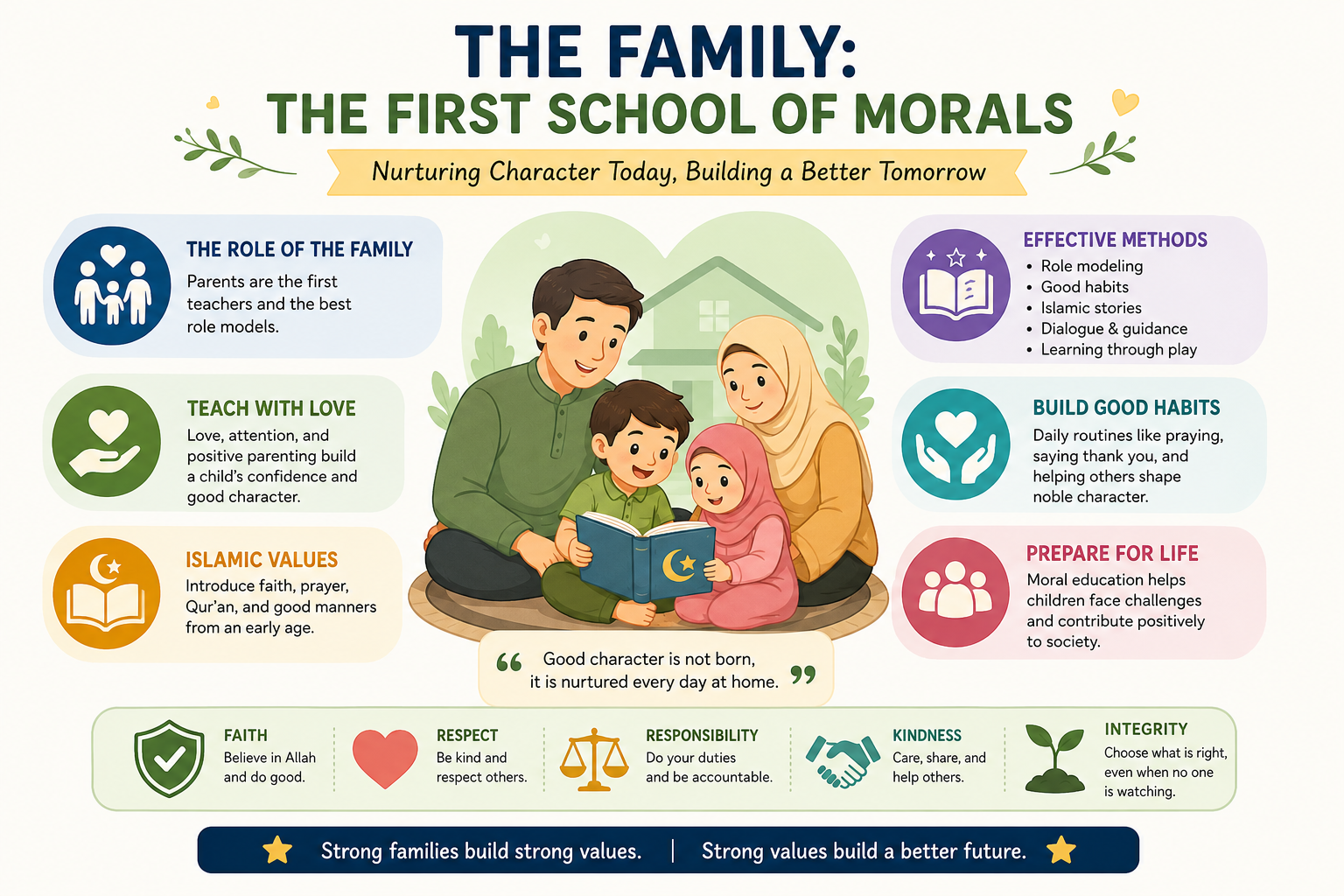
This research aims to explore the role of the family in early childhood moral education from an Islamic perspective, focusing on the views of Imam Al-Ghazali, Ibn Sina, and Abdullah Nasih Ulwan. The research method used is a qualitative literature review, referring to classic books such as Ihya Ulumuddin and various modern sources related to moral education. The results show that the family has a central role as the main agent in instilling moral values through modeling, habituation, and teaching Qur'anic values from an early age. Moral education not only covers moral aspects but also equips children with practical skills to become productive members of society. This research emphasizes the importance of methods such as tadarrus, Islamic stories and daily prayers in building a child's spiritual and intellectual foundation. With the implementation of appropriate strategies, families can strengthen their function as primary educators in a modern era filled with the challenges of globalization and technological advancement. The findings provide practical insights for parents and educators to educate children holistically to grow into individuals who are civilized, have integrity, and are beneficial to humanity.
Keywords:
Moral Education, Family, Early Childhood.
Downloads
References
Abdurrahman, A. (2019). Efforts to improve the development of religious and moral values through exemplary methods in early childhood. Reality Journal of Guidance and Counseling, 4(1). https://doi.org/10.33394/realita.v4i1.2150
Adwiah, A., Karomah, R., & Juleha, S. (2024). Analysis of Abdullah Nashih Ulwan's Educational Methods in Early Childhood Religious and Moral Value Education: Sinta Journal Analysis 2-5. Nanaeke Indonesian Journal of Early Childhood Education, 7(1), 1-19. https://doi.org/10.24252/nananeke.v7i1.38260
Ahad, M. and Perawironegoro, D. (2024). A critical study of the effectiveness of children's education methods according to Abdullah Nashih Ulwan. Journal of Dzurriyat Journal of Early Childhood Islamic Education, 2(2), 46-57. https://doi.org/10.61104/dz.v2i2.320
Aini, N., Istiqomah, L., Delianti, P., Wibowo, M., & Zakiyah, Z. (2023). The habit of tahfidzul qur'an in increasing the love of reading the Qur'an in students. JPMP, 1(1), 47-58. https://doi.org/10.61813/jpmp.v0i0.59
Amalia, N. and Zuhro, D. (2022). Analysis of the management of madrasah ibtidaiyah character education in realizing a generation with moral character. Journal of Basicedu, 6(2), 2370-2379. https://doi.org/10.31004/basicedu.v6i2.2450
Amaliati, S. (2020). The concept of tarbiyatul aulad fi al-islam abdullah nashih ulwan and its relevance to Islamic education for "kidz jaman now". Child Education Journal, 2(1), 34-47. https://doi.org/10.33086/cej.v2i1.1520
Amilda, A. (2017). Early childhood character formation through habituation. Raudhatul Athfal Journal of Early Childhood Islamic Education, 1(2). https://doi.org/10.19109/ra.v1i2.2684
Anggraeni, Y., Drupadi, R., & Syafrudin, U. (2021). The influence of family communication patterns on early childhood emotional development. Journal of Children's Education, 7(1), 19-25. https://doi.org/10.23960/jpa.v7n1.22279
Aninora, N., M, R., Handayani, W., & Asmawati, D. (2023). Parenting builds closeness to the heart with children through storytelling. Journal of Social Service, 1(2), 21-26. https://doi.org/10.59837/kzaea070
Anna, D. (2018). The role of value education in looking at the future of Islam (a study of the thought of Abdullah Nasih Ulwan). Edutainment Journal of Education and Education, 5(2), 17-23. https://doi.org/10.35438/e.v5i2.70
Ansori, Y. (2023). The role of parents in character development for early childhood. JSK, 1(1), 10-14. https://doi.org/10.31949/jsk.v1i1.6225
Anwar, R., Rukmana, E., & Saepudin, E. (2023). Storytelling as an educational da'wah method to form children's Islamic character. Anida (Actualization of the Nuances of Da'wah Science), 23(2), 129-150. https://doi.org/10.15575/anida.v23i2.29361
Asyikin, N., Wahyuni, W., & Rafelia, W. (2024). Islamic educational thinking according to al-ghazali: developing spiritual wisdom in the learning process. Journal of Management Education Social Sciences Information, 1(2), 227-234. https://doi.org/10.57235/mesir.v1i2.2911
Ayni, N., Azizah, R., & Pribadi, R. (2022). The effect of habituation activities on the formation of discipline character. Journal of Education and Entrepreneurship, 10(1), 267-277. https://doi.org/10.47668/pkwu.v10i1.353
Ayu, S. and Junaidah, J. (2019). Moral development in early childhood education. Al-Idarah Journal of Islamic Education, 8(2), 210-221. https://doi.org/10.24042/alidarah.v8i2.3092
Azzahrah, D. and Katoningsih, S. (2023). The effect of habituation of noble morals in early childhood on communication with parents. Journal of Early Childhood Education Obsession, 7(3), 3215-3226. https://doi.org/10.31004/obsesi.v7i3.4380
Cahyaningrum, E., Sudaryanti, S., & Purwanto, N. (2017). Development of early childhood character values through habituation and example. Journal of Child Education, 6(2), 203-213. https://doi.org/10.21831/jpa.v6i2.17707
Ernawati, E. (2017). Children's moral education in the perspective of abdulah nasih ulwan and its relevance to current conditions. Adabiyah Jurnal Pendidikan Islam, 2(1), 107-120. https://doi.org/10.21070/ja.v1i3.1234
Fajriati, R. and Prastiani, Y. (2022). Implementation of early childhood character values through example and habituation. Al-Abyadh, 5(1), 9-14. https://doi.org/10.46781/al-abyadh.v5i1.466
Farikhah, D. and Sikin, N. (2022). The urgency of the role of parents in Islamic religious education. Edudeena, 6(1), 23-34. https://doi.org/10.30762/ed.v6i1.116
Fitri, M. and Naimah, N. (2020). Factors that affect moral development in early childhood. Al-Athfaal Scientific Journal of Early Childhood Education, 3(1), 1-15. https://doi.org/10.24042/ajipaud.v3i1.6500
Hafijhin, M. (2018). The concept of children's character education according to Imam al-ghazali in the book Ayyuha al-Walad. Al-Falah Scientific Journal of Islam and Society, 18(1), 30-57. https://doi.org/10.47732/alfalahjikk.v18i1.53
Hafiz, A. and Walidin, W. (2024). The concept of educators and learners according to al ghazali (an ontological, epistimological and axiological review). JoME, 1(02), 109-115. https://doi.org/10.61683/jome.v1i02.58
Hafizi, Z. (2023). The importance of moral education in the formation of children's character. Ijgie (International Journal of Graduate of Islamic Education), 4(2), 345-350. https://doi.org/10.37567/ijgie.v4i2.2527
Hambali, H. (2020). Character education from the perspective of Ibn Sina. Al-Ikhtibar Journal of Education, 7(1), 737-748. https://doi.org/10.32505/ikhtibar.v7i1.612
Hamzah, H. (2019). Moral education in early childhood from an Islamic perspective. Al-Wardah, 12(1), 59. https://doi.org/10.46339/al-wardah.v12i1.134
Harahap, A. (2021). The importance of character education for early childhood. Journal of Early Childhood, 7(2), 49. https://doi.org/10.24114/jud.v7i2.30585
Herlina, H., Syarifuddin, S., & Susiba, S. (2023). The perspective of the Qur'an and fiqh in building quality family education. Instructional Development Journal, 6(1), 27. https://doi.org/10.24014/idj.v6i1.24429
HRP, M., Kasim, T., & Yussuf, A. (2022). Analysis of moral education in the book mau'izhatul mu'minin min ihya' 'ulumuddin. Malaysian Journal of Social Sciences and Humanities (Mjssh), 7(4), e001452. https://doi.org/10.47405/mjssh.v7i4.1452
Husna, R. (2022). Description of the home environment and parental behavior in the prevention of respiratory allergies in children in the work area of the Batupuh I Health Center in Tanah Datar Regency, West Sumatra Province. Kuala Shia Medical Journal, 22(1). https://doi.org/10.24815/jks.v22i1.24868
Indriyani, R., Lestari, W., & Setiawan, F. (2023). The urgency of education management in the formation of student character. Journal of Language and Cultural Education, 2(1), 63-70. https://doi.org/10.55606/jpbb.v1i2.981
Ismail, I. (2016). Character education based on religious values: an islamic perspective. Ta Dib, 21(1), 41-58. https://doi.org/10.19109/td.v21i1.744
Karimullah, S. (2023). Character education in islamic sufism perspective. Journal of Islamic Education and Social Issues, 21(2), 72-94. https://doi.org/10.37216/tadib.v21i2.1301
Kurniasih, I., Rohmatulloh, R., & Ayyubi, I. (2023). The influence of moral faith education on social behavior. Al-Mau Izhoh, 4(2), 48. https://doi.org/10.31949/am.v4i2.4626
Kurniawan, S. (2018). Character education in Islam al-ghazali thinking about children's character education based on akhlaq al-karimah. Tadrib Journal of Islamic Religious Education, 3(2), 197. https://doi.org/10.19109/tadrib.v3i2.1792
Kurniawati, I., Silvya, W., & Sari, H. (2023). Al-ghazali's thoughts on the philosophy of Islamic education and character formation: its relevance for society. Tawshiyah Journal of Socio-Religious and Islamic Education, 18(2), 57-72. https://doi.org/10.32923/taw.v18i2.4014
Kuswanto, C., Nabela, U., Uminar, A., & Ahmad, M. (2021). Tips for developing good behavior (akhlakul karimah) in early childhood. Asghar Journal of Children Studies, 1(1), 30-39. https://doi.org/10.28918/asghar.v1i1.4148
Maghriza, M. and Nursikin, M. (2024). Value education approach in Islamic philosophy: an analysis of the contributions of Imam al-Ghazali and Ibn Sina. Journal of Educational Research and Evaluation, 5(2), 295-314. https://doi.org/10.59698/afeksi.v5i2.253
Marzuki, G. and Setyawan, A. (2022). The role of parents in children's education. Journal of Language and Cultural Education, 1(1), 53-62. https://doi.org/10.55606/jpbb.v1i1.809
Maula, A. (2021). Character education in Islam: Ibn Miskawaih's philosophical analysis in the book of tahzibul akhlak. Student Scientific Journal of Raushan Fikr, 10(1), 68-76. https://doi.org/10.24090/jimrf.v10i1.4684
Mukti, F. (2018). Integration of science literacy and moral values in the era of globalization. Abdau Journal of Madrasah Education Ibtidaiyah, 1(1), 318-338. https://doi.org/10.36768/abdau.v1i2.18
Musfiroh, I. and Iskandar, I. (2021). The concept of family education from the perspective of the Qur'an and hadith. Journal of Tarbiyah and Teacher Training of Borneo, 2(3), 163-177. https://doi.org/10.21093/jtikborneo.v2i3.4096
Najmi, A. and Rochimah, N. (2021). The concept of social education in the book Tarbiyatul Aulad fil Islam by Abdullah Nasih 'ulwan. Suhuf, 33(2), 111-124. https://doi.org/10.23917/suhuf.v33i2.16581
Nor, N., Abdullah, S., & Rahman, S. (2019). Islamic counseling approach by abdullah nasih ulwan for preventing aggressive behaviour among school students. Malaysian Journal of Social Sciences and Humanities (Mjssh), 4(7), 1-10. https://doi.org/10.47405/mjssh.v4i7.302
Oktavia, D. and Madya, J. (2021). Efforts to instill moral education through the illustrated story method in early childhood. Journal of Syntax Admiration, 2(2), 203-217. https://doi.org/10.46799/jhs.v2i2.186
Parina, P., Handrianto, B., & Hamat, A. (2021). Parents as educators in the perspective of Abdullah Nasih Ulwan. Tawazun Journal of Islamic Education, 14(1), 15. https://doi.org/10.32832/tawazun.v14i1.4017
Pulungan, M. and Harahap, E. (2023). Implementation of the play-while learning system in the development of early childhood education in one-stop kindergarten. MJPKM, 1(1), 61-76. https://doi.org/10.62086/mjpkm.v1i1.402
Putri, A., Yuliharti, Y., & Yanti, Y. (2021). Islamic education thinking according to dr. abdullah nashih ulwan. Kutubkhanah, 20(1), 19. https://doi.org/10.24014/kutubkhanah.v20i1.13341
Rahman, M. (2019). Methods of educating children's morals in the perspective of imam al-ghazali. Equalita Journal of Gender and Child Studies, 1(2), 30. https://doi.org/10.24235/equalita.v1i2.5459
Rahmatullah, A. (2017). The conception of compassion education and its contribution to the psychological building of Islamic education. Literacy (Journal of Educational Sciences), 5(1), 29. https://doi.org/10.21927/literasi.2014.5(1).29-52
Rantikasari, I., Rohmah, U., & Diana, R. (2023). Early childhood moral formation through educational verbal communication. Journal of Early Childhood Education Obsession, 7(5), 6365-6375. https://doi.org/10.31004/obsesi.v7i5.3742
Rasyid, I. (2019). Ibn Sina's concept of education about educational objectives, curriculum, learning methods, and teachers. Journal of Legal and Education Research, 18(1), 779-790. https://doi.org/10.30863/ekspose.v18i1.368
Rochana, S. and Bungsu, M. (2019). Participation of parents and community leaders in early childhood education "inspirational shoots" in Cihampelas Village, Cihampelas District, West Bandung Regency. Comm-Edu (Community Education Journal), 2(2), 126. https://doi.org/10.22460/comm-edu.v2i2.2571
Sabarudin, M., Ayyubi, I., Rohmatulloh, R., Suryana, I., & Wijaya, T. (2024). Exploring the foundations of islamic education: insights from ibn sina and ibn khaldun. Tribakti Journal of Islamic Thought, 35(1), 127-142. https://doi.org/10.33367/tribakti.v35i1.4266
Saihu, M. (2022). Contextualization of Ibn Sina's educational thinking in the contemporary era. Journal of Islamic Education and Islamic Education Management, 3(2), 286-295. https://doi.org/10.36671/andragogi.v3i2.227
Salim, N., Djam'annuri, D., & Aminullah, A. (2018). A comparative study of the concept of children's character education according to al-ghazali and thomas lickona. Manarul Qur an Scientific Journal of Islamic Studies, 18(2), 135-153. https://doi.org/10.32699/mq.v18i2.944
Salsabilla, N. and Nasrulloh, N. (2024). Honoring guests: analysis of surah adz-dzariyat verses 24-27 the perspective of imam ghazali in ihya ulumuddin. JIMR, 2(11), 233-245. https://doi.org/10.62504/jimr998
Sari, O. and Handayani, T. (2022). The relationship between parental parenting and the formation of religious character of integrated Islamic elementary school students. Journal of Pendas Horizon, 8(4), 1011-1019. https://doi.org/10.31949/jcp.v8i4.2768
Setiardi, D. (2017). Family as a source of character education for children. Tarbawi Journal of Islamic Education, 14(2). https://doi.org/10.34001/tarbawi.v14i2.619
Setiawan, E. (2017). The concept of children's moral education from the perspective of imam al ghazali. Journal of Education, 5(1), 55-70. https://doi.org/10.24090/jk.v5i1.1252
Shaleh, M. and Fadhilah, M. (2022). The application of religious moderation in early childhood institutions in Southeast Sulawesi. Journal of Early Childhood Education Obsession, 6(6), 5933-5945. https://doi.org/10.31004/obsesi.v6i6.2903
Sholeh, S. (2017). Moral education in the family environment according to Imam Ghazali. Al-Thariqah Journal of Islamic Religious Education, 1(1), 55-70. https://doi.org/10.25299/althariqah.2016.vol1(1).618
Somad, M. (2021). The importance of Islamic religious education in shaping children's character. Qalamuna Journal of Social and Religious Education, 13(2), 171-186. https://doi.org/10.37680/qalamuna.v13i2.882
Sriasih, N. and Rahyanti, N. (2022). An overview of sleep quality in school-age children during the covid-19 pandemic. Medical Tower, 4(2). https://doi.org/10.31869/mm.v4i2.3187
Sulthoni, S. (2016). Inculcating ethical values in elementary schools. Elementary School of Educational Theory and Practice, 25(2), 100-108. https://doi.org/10.17977/um009v25i22016p100
Suprapto, S. (2020). Integration of religious moderation in the development of Islamic religious education curriculum. Education Journal of Religious and Religious Education Research, 18(3), 355-368. https://doi.org/10.32729/edukasi.v18i3.750
Syihabuddin, M., Manggala, K., Mahfudhoh, R., Huda, L., & Alfani, A. (2023). Implementation of Ibn Sina's scientific integration-interconnection thinking in Islamic education. Setyaki Journal of Islamic Religious Studies, 1(4), 12-22. https://doi.org/10.59966/setyaki.v1i4.626
Tambunan, A. and Hafidz, H. (2024). The value of children's education in the book tarbiyatul aulad fil islam by dr. abdullah nashih 'ulwan. Murhum Journal of Early Childhood Education, 5(1), 343-356. https://doi.org/10.37985/murhum.v5i1.543
Trisnawati, W. and Sugito, S. (2020). Children's education in the family in the covid-19 era. Journal of Early Childhood Education Obsession, 5(1), 823-831. https://doi.org/10.31004/obsesi.v5i1.710
Uni, S. (2020). An analysis of educational thinking according to Ibn Sina and its contribution to Islamic education in the modern era. Journal of Islamic Education Research, 1(3), 225-238. https://doi.org/10.35719/jier.v1i3.39
Urbaningkrum, S., Ichsan, Y., Rahma, A., & Iklima, I. (2022). The application of the story method through animated videos in moral education. Darul Ilmi Journal of Education and Islam, 9(2), 231-243. https://doi.org/10.24952/di.v9i2.3899
Wahyuni, F. and Azizah, S. (2020). Play and learn in early childhood. Al-Adabiya Journal of Culture and Religion, 15(01), 161-179. https://doi.org/10.37680/adabiya.v15i01.257
Wahyuni, N. and Fadriati, F. (2022). Integration of the concept of patience in moral and psychological education. Al-Ilmi Journal of Islamic Education, 5(2), 116. https://doi.org/10.32529/al-ilmi.v5i2.2105
Wajdi, F. (2021). Management of elementary school student development through the role of teachers and parents during the pandemic. Jamp Journal of Education Administration and Management, 4(1), 41. https://doi.org/10.17977/um027v4i12021p41
Wibowo, W. and Udayani, R. (2021). The relevance of Ibn Sina's thought to education in the modern era. Heutagogia Journal of Islamic Education, 1(2), 79-94. https://doi.org/10.14421/hjie.2021.12-07
Widarnandhana, I., Ariani, N., & Jayadiningrat, M. (2023). The role of parents in preparing early childhood towards elementary school education. Pratama Widya Journal of Early Childhood Education, 8(2), 144-155. https://doi.org/10.25078/pw.v8i2.3103
Yuliani, A., Muhammad, H., Z, K., Adrian, A., & Hanif, H. (2023). Ibn Sina's religious-rational and its relevance to contemporary Islamic education. Nusantara Journal of Indonesian Education, 3(3), 523-548. https://doi.org/10.14421/njpi.2023.v3i3-10
Zain, A. and Manik, Y. (2023). Moral education literature in the perspective of the book of ayyuhal walad by imam al-ghazali. Edu Cendikia Scientific Journal of Education, 3(01), 191-195. https://doi.org/10.47709/educendikia.v3i01.2408
Zamroni, A. (2017). Moral education strategies in children. Journal of Gender Studies, 12(2), 241. https://doi.org/10.21580/sa.v12i2.1544
Downloads
Published
How to Cite
Issue
Section
License
Copyright (c) 2025 Mushoffatin Ni’mah, Nita Yuli Astuti

This work is licensed under a Creative Commons Attribution-NonCommercial-ShareAlike 4.0 International License.
This work is licensed under a Creative Commons Attribution-NonCommercial-ShareAlike 4.0 International License.
The copyright of the received article shall be assigned to the journal as the publisher of the journal. The intended copyright includes the right to publish the article in various forms (including reprints). The journal maintains the publishing rights to the published articles. Authors are allowed to use their articles for any legal purposes deemed necessary without written permission from the journal with an acknowledgment of initial publication to this journal.