Fatherless in Perspective Family Philosophy: Can it Undermine a Child's Motivation to Learn?
DOI:
https://doi.org/10.67046/sjse.v1i01.18Keywords:
Fatherless, learning motivation, family educationAbstract
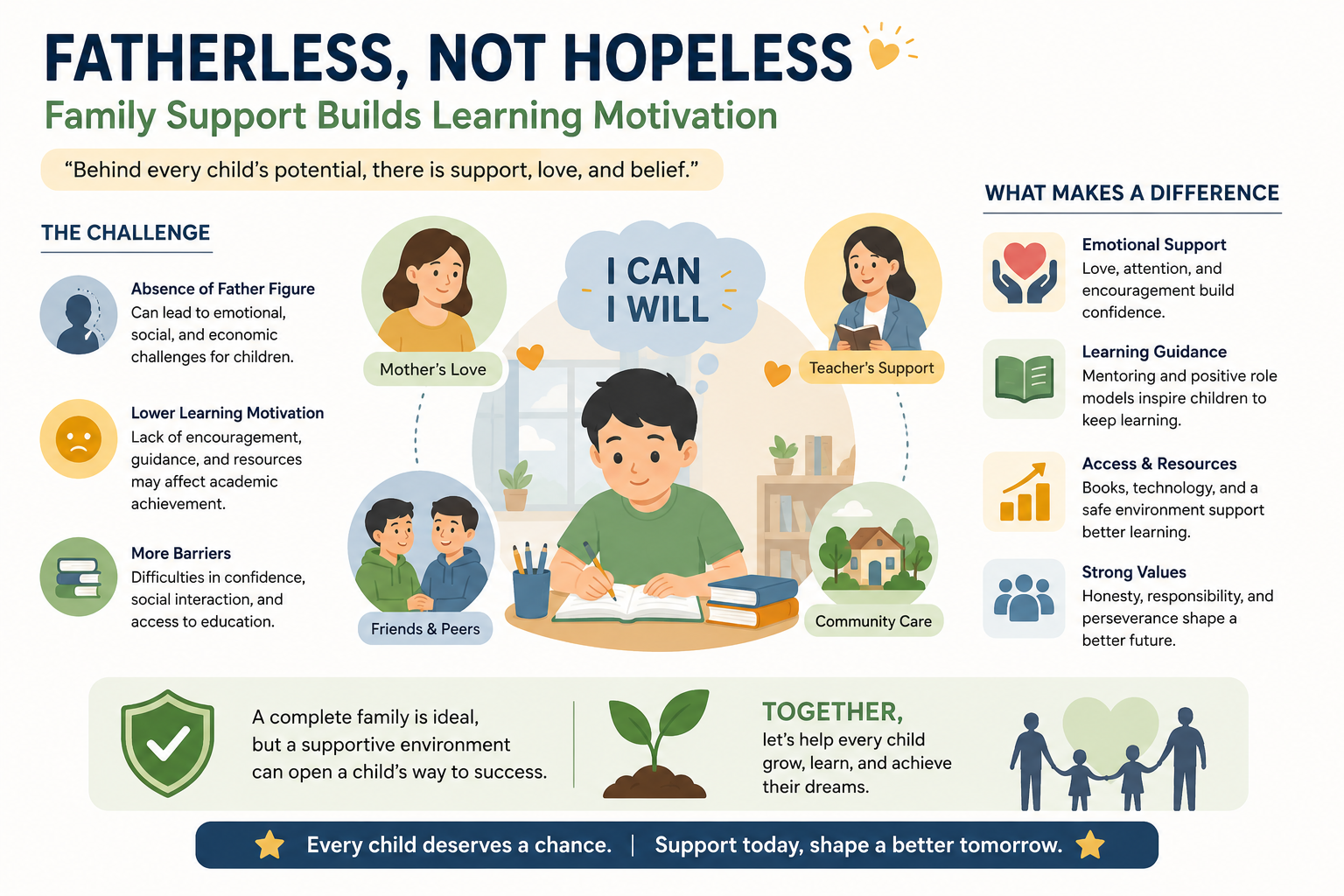
This study aims to examine the impact of the fatherless phenomenon on children's learning motivation from the perspective of family education philosophy. Secondary data were analyzed through a review of the relevant literature. The theoretical framework of this research is based on the thoughts of John Dewey, Abraham Maslow, and Carl Rogers regarding the role of the family in character formation and intrinsic motivation. The results of the study show that the absence of a father figure can significantly reduce children's motivation to learn due to the psychological, social, and economic challenges faced. Lack of emotional support, difficulties in social interaction, and limited educational resources are inhibiting factors. However, the research also highlights the importance of the role of mothers and the surrounding environment in providing support, as well as strengthening family values as capital to build positive learning motivation in fatherless children. The implications of this study emphasize the need for comprehensive and collaborative interventions between families, schools, and communities. Counseling, mentoring, use of educational technology, and economic empowerment programs for single families are recommended as strategies to support the academic and social-emotional development of fatherless children, so that they can reach their maximum potential even in the condition of an incomplete family.
Downloads
References
Adamsons, K., & Johnson, S. K. (2013). An Updated and Expanded Meta-Analysis of Nonresident Fathering and Child Well-Being. Journal of Family Psychology. https://doi.org/10.1037/a0033786
Arsad, N. M., Vabrianto, R., Syafaren, A., & Tuan Soh, T. M. (2017). Peranan Bapa Dalam Mewujudkan Keadilan Gender Dalam Rumah Tangga: Islam Dan Sains. Marwah: Jurnal Perempuan, Agama Dan Jender, 16(2), 169. https://doi.org/10.24014/marwah.v16i2.4138
Ashari, Y. (2018). Fatherless in Indonesia and Its Impact on Children’s Psychological Development. Psikoislamika Jurnal Psikologi Dan Psikologi Islam. https://doi.org/10.18860/psi.v15i1.6661
Asiva Noor Rachmayani. (2015). Peran Ayah Terhadap Pendidikan Keagamaan Anak Usia Dini. 6.
Augustine, J. M., Nelson, T. J., & Edin, K. (2009). Why Do Poor Men Have Children? Fertility Intentions Among Low-Income Unmarried U.S. Fathers. The Annals of the American Academy of Political and Social Science. https://doi.org/10.1177/0002716209334694
Bell, R. (2021). Underpinning the Entrepreneurship Educator’s Toolkit: Conceptualising the Influence of Educational Philosophies and Theory. Entrepreneurship Education. https://doi.org/10.1007/s41959-020-00042-4
Cowan, P. A., Cowan, C. P., Pruett, M. K., Pruett, K. D., & Wong, J. J. (2009). Promoting Fathers’ Engagement With Children: Preventive Interventions for Low‐Income Families. Journal of Marriage and Family. https://doi.org/10.1111/j.1741-3737.2009.00625.x
Diadara, S., & Utama, P. B. (2025). Pemanfaatan Aplikasi Canva dalam Meningkatkan Hasil Belajar Pendidikan Agama Islam Kelas IV SD Al Qur ’ an Wahdah Islamiyah Bontang Tahun Pelajaran 2023 / 2024 Pendahuluan. 3.
East, L., Jackson, D., & O’Brien, L. (2006a). Father absence and adolescent development: A review of the literature. Journal of Child Health Care, 10(4), 283–295. https://doi.org/10.1177/1367493506067869
East, L., Jackson, D., & O’Brien, L. (2006b). Father Absence and Adolescent Development: A Review of the Literature. Journal of Child Health Care. https://doi.org/10.1177/1367493506067869
Genesoni, L., & Tallandini, M. A. (2009). Men’s Psychological Transition to Fatherhood: An Analysis of the Literature, 1989–2008. Birth. https://doi.org/10.1111/j.1523-536x.2009.00358.x
Istikomah, N., Wardana, M. Y. S., & Saputra, H. J. (2022). Analisis Dampak Game Online Terhadap Aspek Kehidupan Sosial pada Siswa Kelas V SD N 07 Kendaldoyong Kecamatan Petarukan Kabupaten Pemalang. Sustainability (Switzerland), 6(1), 1–9.
Jainiyah, J., Fahrudin, F., Ismiasih, I., & Ulfah, M. (2023). Peranan Guru Dalam Meningkatkan Motivasi Belajar Siswa. Jurnal Multidisiplin Indonesia, 2(6), 1304–1309. https://doi.org/10.58344/jmi.v2i6.284
Jensen, P. S., Grogan, D., Xenakis, S. N., & Bain, M. W. (1989). Father Absence: Effects on Child and Maternal Psychopathology. Journal of the American Academy of Child & Adolescent Psychiatry. https://doi.org/10.1097/00004583-198903000-00004
Lismayanti, I., Gunawan, Y. A., Budiarti, L. S., Sukatin, S., & Yusup, M. (2023). Teori Pendidikan Keluarga dan Tanggung Jawab Orang Tua dalam Pendidikan Anak Usia Dini. Hijaz: Jurnal Ilmu-Ilmu Keislaman, 2(1), 20–26. https://doi.org/10.57251/hij.v2i1.864
Markowitz, A. J., & Ryan, R. M. (2016). Father Absence and Adolescent Depression and Delinquency: A Comparison of Siblings Approach. Journal of Marriage and Family. https://doi.org/10.1111/jomf.12343
McLanahan, S., Tach, L., & Schneider, D. (2013). The Causal Effects of Father Absence. Annual Review of Sociology. https://doi.org/10.1146/annurev-soc-071312-145704
Ningtyas, K. K., Rokhmah, M. N., Ananta, M., Sa’adah, N., & Nasikhin. (2023). Filsafat Pendidikan Keluarga dalam Pendidikan Islam. Tsurayya Jurnal Pendidikan Agama Islam Sekolah Tinggi Agama Islam Mempawah, 1–10.
Nurhawa, A., Halim, B., & Mubarat, H. (2023). Kampanye Sosial Stop Fatherless Pada Figur Seorang Ayah Di Kota Palembang. VisArt: Jurnal Seni Rupa Dan …, 370–385. https://ejournal.lapad.id/index.php/visart/article/view/309%0Ahttps://ejournal.lapad.id/index.php/visart/article/download/309/303
Rismawati, R., Munawaroh, N., & Saifullah, I. (2024). Jiic : Jurnal Intelek Insan Cendikia Vol : 1 No : 8 , Oktober 2024 Konsep Pendidikan Moral dalam Al-Qur ’ an Surat Al Baqarah Ayat 31-32 ( Perspektif Ilmu Pendidikan Islam ) The Concept of Moral Education in the Qur ’ an Surah Al Baqarah Verses 31-32 ( Pe. 3631–3652.
Sari, L. S. P., Oktavianti, I., & Kironoratri, L. (2023). Dampak Keluarga Broken Home Terhadap Motivasi Belajar Anak. Jurnal Educatio FKIP UNMA, 9(2), 1153–1159. https://doi.org/10.31949/educatio.v9i2.5010
Uslu, Ş. S., & Demiriz, S. (2022). Erken Çocuklukta Yılmazlığın Yordayıcısı Olarak Sosyal Değerler Kazanımı. Eğitim Bilimleri Dergisi. https://doi.org/10.15285/maruaebd.1050414
Widiya, D., & Astuti, P. (2025). Fenomena Fatherless Dalam Perspektif Al- Qur ’ an ( Kajian tentang Relasi Ayah dan Anak dalam Kisah Al- Qur ’ an ). 2(1), 70–83.
Downloads
Published
How to Cite
Issue
Section
License
Copyright (c) 2025 Latifatus Maulida, Karnadi

This work is licensed under a Creative Commons Attribution-NonCommercial-ShareAlike 4.0 International License.
This work is licensed under a Creative Commons Attribution-NonCommercial-ShareAlike 4.0 International License.
The copyright of the received article shall be assigned to the journal as the publisher of the journal. The intended copyright includes the right to publish the article in various forms (including reprints). The journal maintains the publishing rights to the published articles. Authors are allowed to use their articles for any legal purposes deemed necessary without written permission from the journal with an acknowledgment of initial publication to this journal.