The Nature of Human Beings in Al Ghazali's Thought and Its Implications on Character Education
DOI:
https://doi.org/10.67046/sjse.v1i01.19Keywords:
Al-Ghazali; human nature; character educationAbstract
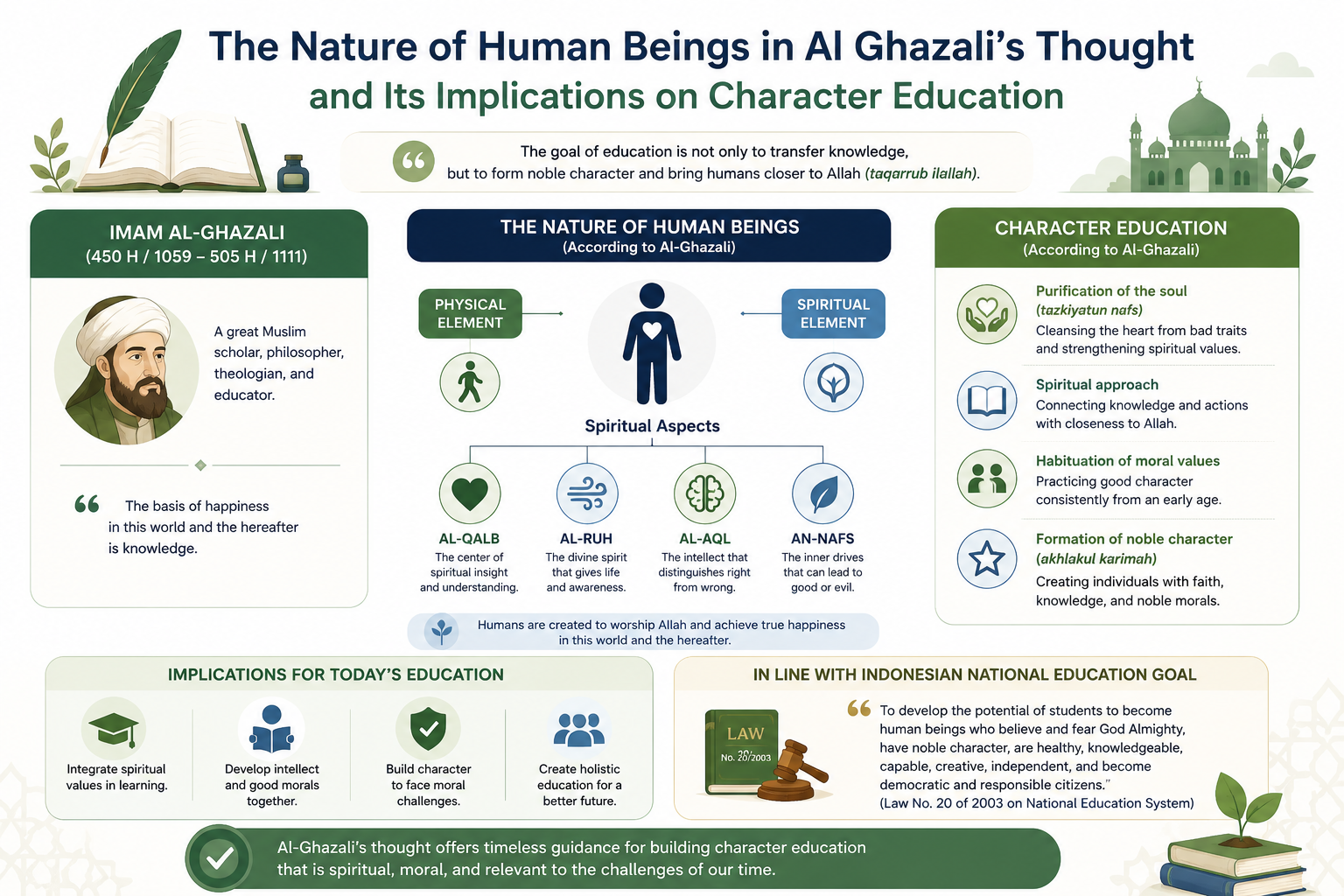
This research aims to examine the concept of human nature in the perspective of Imam al-Ghazali's thought and its implications for character education. This research uses a qualitative approach with the method used is literature research. In al-Ghazali's view, humans consist of physical and spiritual elements. Al-Ghazali emphasizes the dominance of spiritual aspects such as qalb, spirit, aql, and nafs as the core of humanity that determines the direction of human life Character education according to Al-Ghazali not only aims to transfer knowledge, but also to form noble morals through purification of the soul (tazkiyatun nafs), spiritual approaches, and habituation of moral values from an early age. The implications of Al-Ghazali's thinking are very relevant to the goals of Indonesian national education as stated in the National Education System Law No. 20 of 2003, which emphasizes the formation of people of faith, piety, knowledge, and noble character. The contribution of this research is to provide theoretical and practical insights into the importance of integrating spiritual values in character education, so that it can be a foothold for the development of holistic education models that are in accordance with the challenges of the times. This research also shows that character education based on akhlakul karimah can be an effective solution in overcoming moral degradation among today's young generation.
Downloads
References
Achruh, A., Pasinringi, A. B., Achruh, A., & Pasinringi, A. B. (2023). Memahami Hakikat Manusia Dalam Pandangan Filsafat Pendidikan Islam. Al-Afkar : Journal for Islamic Studies, 6(4), 312–320. https://doi.org/10.31943/afkarjournal.v6i4.780.Understanding
Al-Ghazali, A. H. (1900). Ihya’ Ulum Al-din. Maktabah al-iman.
Al-Ghazali, A. H. (1994). Ihya Ulum Al-din (H. I. Yakub (trans.); Jilid 2, C). Jakarta ; CV. Faizan.
Dirsa, A., & Kusumawati, I. (2019). Implementasi Pemikiran Imam Al-Ghazali tentang Pendidikan Karakter. AoEJ: Academy of Education Journal, 10(2), 159–169. https://doi.org/https://doi.org/10.47200/aoej.v10i02.281
Fazlur, M., Hadi, R., & Jayadi, M. (2024). Peran Guru dalam Menanamkan Pendidikan Karakter Peserta Didik Menurut Pandangan Islam. Jurnal Manajemen Pendidikan Dan Ilmu Sosial (JMPIS), 5(3), 447–452. https://doi.org/https://doi.org/10.38035/jmpis.v5i3
Fikri, M. K. (2022). Imam Al-Ghazali (Biografi Lengkap Sang Hujjatul Islam). PT. Laksana.
Hakim, T. (2004). Kamus At-Taufiq (Arab-Jawa-Indonesia).
Hasanah. (2016). Manusia Dalam Pandangan Imam Al-Ghazali. Journal Visipena, VII, 103–116. https://doi.org/https://doi.org/10.46244/visipena.v7i2.315
Hayati, N., & Sabariyah, H. (2024). Konsep Pendidikan Anak Berkarakter Menurut Pemikiran Imam Al-Ghazali. Jurnal Sadewa : Publikasi Ilmu Pendidikan, Pembelajaran Dan Ilmu Sosial, 2(3), 142–151. https://doi.org/https://doi.org/10.61132/sadewa.v2i3.951
Jahja, H. M. Z. (1996). Teologi al-Ghazali: Pendekatan Metodologi. Yogyakarta : PT. Pustaka Belajar.
Kholil, M. (2024). Khalifah Dalam Melestarikan Lingkungan Hidup (Kajian Ayat Ekologis Perspektif Mufasir Indonesia). Graduasi : Jurnal Kajian Islam Interdisipliner, 1(1), 71–79. https://doi.org/https://doi.org/10.33650/graduasi.v1i1.8238
Mukarromah, Rohman, & Sartika, R. (2022). Pendidikan Karakter Perspektif Al-Ghazali (Analisis terhadap Pemikiran al-Ghazali tentang Pendidikan Karakter Sebagai Solusi Problem Dekadensi Moral dan Signifikansinya dalam Pendidikan di Indonesia). TILA: Jurnal Pendidikan Islam Anak Usia Dini, 2(2), 302–323. https://doi.org/https://doi.org/10.56874/tila.v2i2.1073
Nasr, S. H. (2009). The Heart of Islam: Enduring Values for Humanity. New York : HarperSanFrancisco.
Nuryamin, Damayanti, E., F, H., & Suriyati. (2021). Hakikat Manusia (Perspektif Filsafat pendidikan Islam). Al-Qalam; Jurnal Kajian Islam & Pendidikan, 13(1), 38–48. https://doi.org/https://doi.org/10.47435/al-qalam.v13i1.612
Roni, E., Supriawan, & Suparni. (2024). Hakikat Manusia dan Pendidikan. Jurnal Pendidikan Tambusai, 8(2), 31348–31354.
Ruslan, R. (2017). Metode Penelitian Public Relations dan Komunikasi (Cet.7). Jakarta : PT. Raja Grafindo Persada.
Sahar, A. (2012). Pandangan Al-Ghazali Tentang Pendidikan Moral. An-Nur: Jurnal Studi Islam, 4(2).
Setiawan, A. (2014). Prinsip Pendidikan Karakter dalam Islam: Studi Komparasi Pemikiran Al-Ghazali dan Burhanuddin Al-Zarnuji. Jurnal Dinamika Ilmu, 14(1), 1–12. https://doi.org/https://doi.org/10.21093/di.v14i1.4
Sholihin, M. (2003). Tasawuf Tematik ; Membedah Tema-Tema Penting Tasawuf (Cet. I). Bandung : CV. Pustaka Setia.
Siraj, F. M. (2018). Relevansi konsep jiwa al-ghazali dalam pembentukkan mentalitas yang berakhlak. INQUIRY ; Jurnal Ilmiah Psikologi, Vol. 9(No. 1), 32–45.
Ulfah, A., Barni, M., Basir, A., & Khairuddin, A. (2024). Hakikat dan Potensi Manusia Dalam Implikasinya Pada Pendidikan Islam (Tinjauan Al-Qur-an dan Hadits). Mumtaz : Jurnal Studi Al-Qur’an Dan Keislaman, 8(01), 22–38.
Wibowo, A. H. (2020). Relevansi Pendidikan Karakter Dalam Perspektif Filsafat Al-Ghazali. Al-l’jaz Jurnal Studi Al-Qur’an Falsafah Dan Keislaman, 2(2).
Downloads
Published
How to Cite
Issue
Section
License
Copyright (c) 2025 Nabaha: Journal of Philosophy and Social Sciences

This work is licensed under a Creative Commons Attribution-NonCommercial-ShareAlike 4.0 International License.
This work is licensed under a Creative Commons Attribution-NonCommercial-ShareAlike 4.0 International License.
The copyright of the received article shall be assigned to the journal as the publisher of the journal. The intended copyright includes the right to publish the article in various forms (including reprints). The journal maintains the publishing rights to the published articles. Authors are allowed to use their articles for any legal purposes deemed necessary without written permission from the journal with an acknowledgment of initial publication to this journal.