Integrating Maqashid Shari’a on Cultural Responsiveneness to Constructing Academic Culture
DOI:
https://doi.org/10.67046/sjse.v2i01.54Keywords:
maqashid shari’a, cultural responsivenss, construction academic cultureAbstract
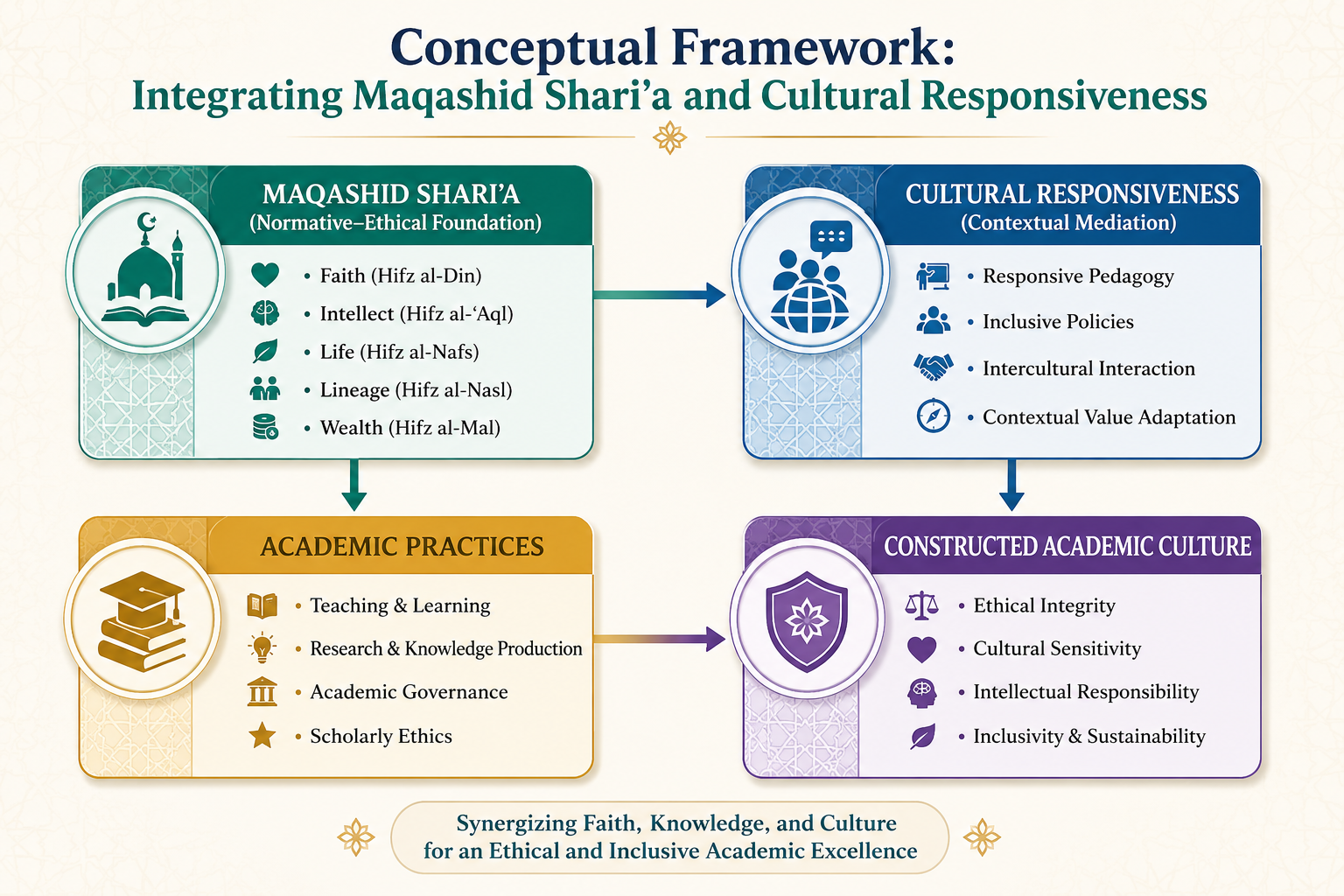
This study aims to develop a culturally responsive instrument based on the principles of Maqashid Syariah to address the cultural identity crisis among students at the State Islamic University of Indonesia. Focusing on the integration of five essential safeguards (faith, life, reason, progeny, and wealth) with a hierarchical culturally responsive model, this study specifically examines how the levels of needs, requirements, and embellishments (tahsiniyyah) can map the inclusive attitudes of students. Using the Systematic Literature Review (SLR) methodology, this study synthesizes existing literature to build a comprehensive framework. The results of the study indicate successful integration, where Maqashid Syariah provides a strong ethical and transcendental foundation for measuring cultural responsiveness, going beyond mere social skills to embody the practice of universal Islamic values such as compassion and modesty. This instrument offers a nuanced and spiritually grounded alternative to conventional secular scales, allowing for a more holistic evaluation of how students navigate cultural plurality while remaining rooted in their religious and local wisdom.
Downloads
References
Ahmad, N., Karimi, M., Fatimah, S., Rahman, A., Rohaniah, S., Mahmood, S., & Asiah, N. (2025). The Islamic Ethical Principles and Maqasid al-Shariah to Enhance Digital Competency Among Adolescents.
Asrori, M., Fandi, B., Sofian, G. Y., Fadhel, A., Hidayat, S., & Suja, A. (2025). Islamic educational and cultural values in Indonesian puppetry art : a systematic literature review. Cogent Education, 12(1). https://doi.org/10.1080/2331186X.2025.2490445
Bin, F., Ismail, H., Sulong, J., Amin, K., & Ahmad, B. (2025). Islamic Values and the Civil State : A Systematic Review on the Application of Maqasid Al-Shariah in Madani Nation-Building. IX(2454), 355–367. https://doi.org/10.47772/IJRISS
Cliff, A., Walji, S., Mogliacci, R. J., Morris, N., & Morris, N. (2022). Unbundling and higher education curriculum : a Cultural-Historical Activity Theory view of process. 2517. https://doi.org/10.1080/13562517.2019.1711050
Fakhruddin, A., Anwar, S., Rindu, M., & Islamy, F. (2025). Enhancing academic self-concept and historical literacy in Islamic studies through collaborative learning : a study on prospective Islamic Education teachers in Indonesia. Cogent Education, 12(1). https://doi.org/10.1080/2331186X.2025.2491871
Hady, M. S., Prastyo, A. T., Bakar, A., Faslah, R., Malik, A., Alam, F., Barkah, Q., Himmatin, U., Nuyulis, I., Puspitasari, N., Zulkifli, M., & Ghani, A. (2025). Cultural transformation : religious moderation from manuscripts heritage to living tradition in Indonesia and Malaysia. Cogent Education, 12(1). https://doi.org/10.1080/2331186X.2025.2556891
Haris, M. A. (2025). Studi Etnografi Tentang Keterkaitan Pendidikan Agama Islam dengan Tradisi Lokal pada Komunitas Petani di Desa Tanjungkerta Kecamatan Kroya Kabupaten Indramayu. 11(1), 32–43.
Hasibuan, H. H. (2017). Pemikiran Maqasid Syariah Jasser Auda. Aqlam: Journal of Islam and Plurality, 4(17200010102), 1–21.
Hultqvist, E., & Lidegran, I. (2021). International Studies in Sociology of Education The use of ‘ cultural capital ’ in sociology of education in Sweden. International Studies in Sociology of Education, 30(3), 349–356. https://doi.org/10.1080/09620214.2020.1785322
Ma, H., & Juhaidi, A. (2025). Multigroup analysis of Islamic Higher Education and General Higher Education in Indonesia : the influence of family socioeconomic background , possibility of success , and self-efficacy on student academic performance with resilience as a mediator Multigroup analysis of Islamic Higher Education and General Higher Education in Indonesia : the influence of family socioeconomic. Cogent Education, 12(1). https://doi.org/10.1080/2331186X.2025.2555038
Mujahid, A., & Aderus, A. (2022). Humanistic Education and the Concept of " Merdeka Belajar " in Indonesia : A Perspective of the Qur ’ an. 14, 5263–5272. https://doi.org/10.35445/alishlah.v14i4.2181
Nisa, L. K. (2025). Penerapan Maqashid Syariah dan Konsep 3P dalam Strategi Scale Up Bisnis Syariah Berkelanjutan di Indonesia.
Nurkahenah, S. (2025). Integrasi Budaya. 10(1), 35–39. https://doi.org/10.33511/misykat.v10n1.35-40
Sanusi, T. O. (2025). Permata : Jurnal Pendidikan Agama Islam Maqasid Al-Shariah as an Evaluative Framework for the Digitalisation of Islamic Education ( Contemporary Hermeneutic Approach Study ). 6(1), 49–63.
Shahama, A., Patel, A., Carson, J., Abdel-khalek, A. M., Shahama, A., Patel, A., Carson, J., Abdel-khalek, A. M., & Carson, J. (2022). The pursuit of happiness within Islam : a systematic review of two decades of research on religiosity and happiness in Islamic groups. Mental Health, Religion & Culture, 25(7), 629–651. https://doi.org/10.1080/13674676.2022.2028748
Shalghoum, N., Yahya, N., & Masuwd, M. (2025). Integrating Maqasid al-Shariah into Higher Education : Enhancing the Role of Faculty in Achieving the SDGs. 4(2), 153–173.
Steele, C., Gower, G., Benson, S., Steele, C., Gower, G., & Benson, S. (2025). Critical Studies in Education Non-Indigenous Initial Teacher Education students navigating the cultural interface Non-Indigenous Initial Teacher Education students navigating the cultural interface. Critical Studies in Education, 66(4), 498–516. https://doi.org/10.1080/17508487.2023.2298200
Tuna, M. H. (2022). The professionalisation of Islamic religious education teachers The professionalisation of Islamic religious education teachers. British Journal of Religious Education, 44(2), 188–199. https://doi.org/10.1080/01416200.2021.1999905
Tuna, M. H. (2024). Fundamentals of a Pluralism-Fostering Islamic Religious Education : Navigating Cultural and Religious Dimensions of Plurality Fundamentals of a Pluralism-Fostering Islamic Religious. Religious Education, 119(4), 321–337. https://doi.org/10.1080/00344087.2024.2384690
Turrif’ah, M. (2014). Internasionalisasi Karakter Religius Melalui Sistem Manajemen Kesiswaan. 257.
Uhr, C., Metzner, F., Pawils, S., Adedeji, A., Jelinek, L., & Morina, N. (2025). Culturally adapted Metacognitive Training for Depression ( CA-D-MCT ) for Arabic- and Farsi- speaking refugees : a feasibility trial Arabic- and Farsi-speaking refugees : a feasibility trial. European Journal of Psychotraumatology, 16(1), 1–12. https://doi.org/10.1080/20008066.2025.2572176
Watkins, M., Noble, G., Watkins, M., & Noble, G. (2022). Reconstituting teachers ’ professional knowledge : using Cultural Studies to rethink multicultural education Cultural Studies to rethink multicultural education. Continuum, 36(5), 671–684. https://doi.org/10.1080/10304312.2022.2049212
Yani, M. T., Roro, R., Setyowati, N., Jatmiko, B., & Ridlwan, A. A. (2025). Transformation of local wisdom values to build elementary and secondary school students ’ characters : a case study in Serang Regency , Banten Province , Indonesia. Cogent Education, 12(1). https://doi.org/10.1080/2331186X.2025.2532225
Zeng, Y., Hallås, B. O., & Sæle, O. O. (2024). Intercultural dialogue on ecopedagogy between Daoism and Naess ’ ecosophy : Comparing and integrating Chinese and Western ecological wisdom Intercultural dialogue on ecopedagogy between Daoism and Naess ’ ecosophy : Comparing and integrating Chinese. Educational Philosophy and Theory, 56(12), 1229–1240. https://doi.org/10.1080/00131857.2024.2376636
Downloads
Published
How to Cite
Issue
Section
License
Copyright (c) 2026 Syahrur Ramli, Gusrina Fadhila; Ramza Husmen; Aidil Darmawan

This work is licensed under a Creative Commons Attribution-NonCommercial-ShareAlike 4.0 International License.
This work is licensed under a Creative Commons Attribution-NonCommercial-ShareAlike 4.0 International License.
The copyright of the received article shall be assigned to the journal as the publisher of the journal. The intended copyright includes the right to publish the article in various forms (including reprints). The journal maintains the publishing rights to the published articles. Authors are allowed to use their articles for any legal purposes deemed necessary without written permission from the journal with an acknowledgment of initial publication to this journal.