Between Divine Destiny and Economic Transactions: A Qualitative Study of Underprivileged People's Perceptions of the Role of Education
DOI:
https://doi.org/10.67046/sjse.v2i01.70Keywords:
education, poor people, theological interventionAbstract
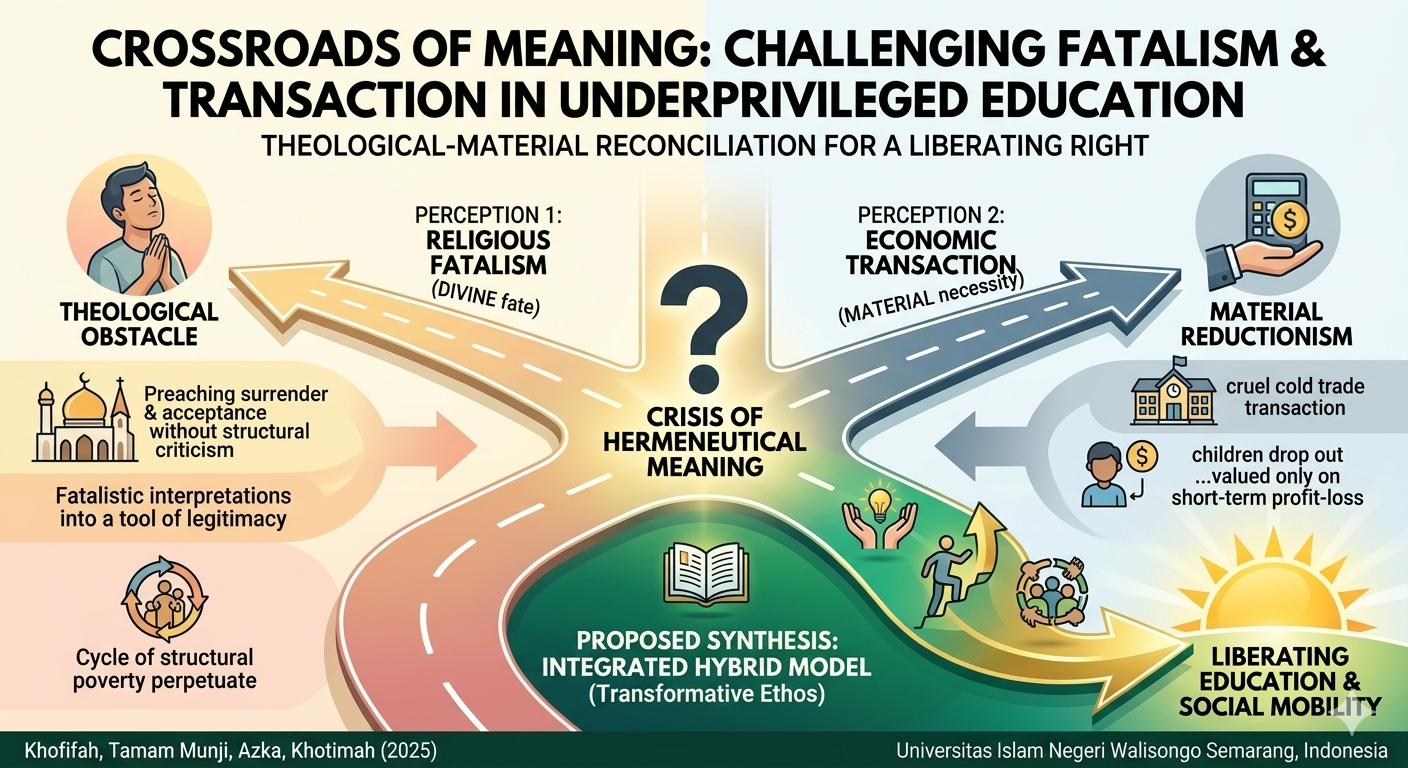
The aim of this study is to critically analyze the dynamics of poor people's perceptions in Sukorejo Village, Kendal, Indonesia regarding whether education functions as a liberating theological intervention or merely as a material necessity for survival. This research employs a qualitative approach with a case study design. Participants were selected purposively, and data were collected through in-depth interviews, participatory observation, and document analysis. Data analysis used the Miles and Huberman interactive model. The findings reveal a dialectical tension between spirituality and economic pragmatism. Community perspectives are divided into three orientations: education as divine destiny, education as an economic transaction, and education as a spiritual-material hybrid. The hybrid perspective is the most dominant but often constrained by economic pressure. This study identifies a hermeneutical meaning crisis as a root problem, where poverty is not only financial but also related to limited understanding of education’s role. This research offers a strategic framework integrating material and spiritual dimensions as an innovative approach to inclusive education policies.
Downloads
References
Amane, A. P. O., Kertati, I., Hastuti, D., Shodiq, L. J., & Ridho’i, M. (2023). Metode Penelitian Kualitatif: Persperktif bidang ilmu Sosial. PT. Sonpedia Publishing Indonesia.
Arifin, S. (2025). Pendidikan Islam Inklusif dan Transformasi Sosial: Analisis Peran Lembaga Keagamaan dalam Mengatasi Kesenjangan Sosial di Pamekasan. Dinamika: Jurnal Studi Kepesantrenan Dan Keislaman, 3(01), 44–56.
Estede, S., Damanik, F. H. S., Santosa, I., Damayanti, E., & Wijaya, M. H. D. (2025). Sosiologi Ekonomi: Teori, Dinamika, dan Transformasi. Star Digital Publishing.
Gammelgaard, B. (2017). The qualitative case study. In The International Journal of Logistics Management (Vol. 28, Issue 4, pp. 910–913). Emerald Publishing Limited.
Hakim, B. R. (2025). SUFI SOCIAL WORK DALAM KONTEKS INDONESIA MODERN: TINJAUAN TEMATIK ATAS KERANGKA TEORETIS DAN PRAKTIK (1990–2024). Share: Social Work Journal, 15(1), 1–12.
Haliim, W., & Fatkhurrohman, M. (2025). Relasi Kuasa dan Klientelisme pada Budaya Politik Masyarakat Miskin Indonesia: Studi Implementasi Program Keluarga Harapan (PKH). Jurnal Pemerintahan Dan Politik, 10(4), 688–705.
Jailani, M. S., & Saksitha, D. A. (2024). Tehnik analisis data kuantitatif dan kualitatif dalam penelitian ilmiah. Jurnal Genta Mulia, 15(2), 79–91.
Karnanta, K. Y. (2013). Paradigma teori arena produksi kultural sastra: Kajian terhadap pemikiran Pierre Bourdieu. Jurnal Poetika, 1(1).
Mulyono, A. (2020). Apologia Pendidikan Kaum Miskin. Guepedia.
Nadziroh, N., Chairiyah, C., & Pratomo, W. (2018). Hak warga negara dalam memperoleh pendidikan dasar di Indonesia. Trihayu, 4(3), 259091.
Noviawati, P., & Narendri, N. I. (2017). Nilai-nilai kemiskinan pada masyarakat miskin di daerah perkotaan dan pedesaan: Ditinjau berdasarkan analisis atribut psikologis. Prosiding Industrial Research Workshop and National Seminar, 8, 265–273.
Nurdiani, N. (2014). Teknik sampling snowball dalam penelitian lapangan. ComTech: Computer, Mathematics and Engineering Applications, 5(2), 1110–1118.
Omayra, Y. (2021). Dimensions and Strategies to Improve The Quality Of Education And Its Impact On The Development Of Community Human Resources: Dimensi dan Strategi Peningkatan Kualitas Pendidikan dan Dampaknya Bagi Pengembangan SDM Masyarakat. Jurnal Bina Ummat: Membina Dan Membentengi Ummat, 4(2), 77–94.
Qomaruddin, Q., & Sa’diyah, H. (2024). Kajian teoritis tentang teknik analisis data dalam penelitian kualitatif: Perspektif Spradley, Miles dan Huberman. Journal of Management, Accounting, and Administration, 1(2), 77–84.
Rahawarin, B., Ahmad, M., & Rochimah, H. (2025). EFEKTIVITAS PROGRAM BANTUAN BEASISWA PENDIDIKAN DALAM MENGURANGI SISWA PUTUS SEKOLAH: TINJAUAN LITERATUR. Jurnal Ilmiah Pendidikan Citra Bakti, 12(4), 1053–1067.
Ruhulessin, C. T. F. (2025). Teologi pembebasan: Praksis berteologi dalam konteks penderitaan. PT. Revormasi Jangkar Philosophia.
Saptadi, N. T. S., Septiani, S., Wardoyo, T. H., Hidayati, W., Thoif, M., Talindong, A., Audia, F., Nashiroh, P. K., Hadikusumo, R. A., & Suroya, L. F. (2025). Pendidikan vokasional: Teori dan praktik. Sada Kurnia Pustaka.
Seneng, S. A., Susilo, S., & Deffinika, I. (2023). Faktor-faktor yang mempengaruhi kemiskinan di Desa Lanamai 1, Kecamatan Riung Barat, Kabupaten Ngada. Jurnal Integrasi Dan Harmoni Inovatif Ilmu-Ilmu Sosial, 3(4), 426–435.
Sitorus, D. A. N., & Sitanggang, P. M. (2025). The Call of the Church in Poverty Liberation: A Theological Study of the Existence of the Church Fighting for the Poor. Jurnal Penelitian Medan Agama, 16(1), 26–42.
Zurwanty, R. H., Indra, N., & Sari, V. P. (2023). Akses Pendidikan Anak Keluarga Miskin (Di Sungai Pisang Kota Padang). Innovative: Journal of Social Science Research, 3(3), 830–838.
Downloads
Published
How to Cite
Issue
Section
License
Copyright (c) 2026 Aeni Nur Khofifah, Ubaidillah, Karina Milatu Azka, Siti Nur Khusnul Khotimah

This work is licensed under a Creative Commons Attribution-NonCommercial-ShareAlike 4.0 International License.
This work is licensed under a Creative Commons Attribution-NonCommercial-ShareAlike 4.0 International License.
The copyright of the received article shall be assigned to the journal as the publisher of the journal. The intended copyright includes the right to publish the article in various forms (including reprints). The journal maintains the publishing rights to the published articles. Authors are allowed to use their articles for any legal purposes deemed necessary without written permission from the journal with an acknowledgment of initial publication to this journal.