The Dynamics of the Decline of Madrasah Diniyah Students: Curriculum Challenges, Family Economy, and the Influence of Digital Technology
DOI:
https://doi.org/10.67046/sjse.v2i01.71Abstract
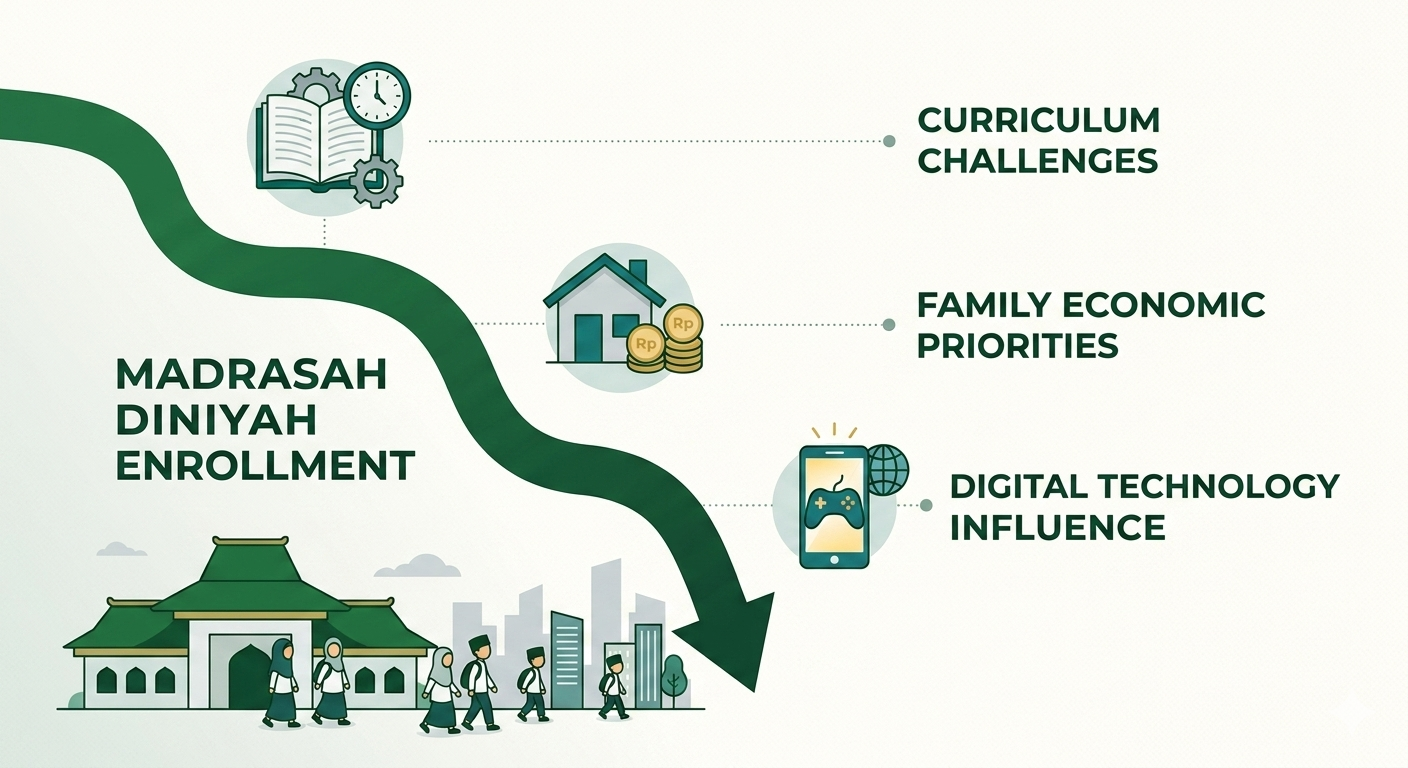
This study specifically conducts a comprehensive analysis of the critical phenomenon of declining enrollment in Madrasah Diniyah schools within Islamic foundations in the Tlogosari Wetan district of Semarang City, Indonesia, from the perspective of contemporary Islamic education. Adopting a qualitative approach with a phenomenological design, data were collected through unstructured interviews, participant observation, and document analysis in Pedurungan Subdistrict, then analyzed using the Miles and Huberman interactive model to ensure empirical validity. Key findings reveal the decline in student enrollment as a multidimensional phenomenon, driven by three dominant, mutually interacting factors: the economic priorities of urban families that prioritize formal education, a stagnant curriculum that is irrelevant to Generation Z, and the penetration of digital technology that diverts children’s interests. These factors exacerbate the marginalization of madrasahs, triggering operational and humanitarian crises such as budget deficits, limited facilities, and the erosion of teachers’ welfare, which significantly reduce the quality of education. Although administrators have implemented digital curriculum innovations, schedule adjustments, and strategic collaborations, these efforts are hindered by limited human and financial resources. Therefore, an urgent holistic intervention is needed that integrates financial management, teacher protection, and sustainable educational methodology transformation through government-community collaboration. The findings of this study provide an empirical basis for strategic policies that not only aim to increase the number of santri but also strengthen the operations and core values of Islamic education, adapting them to urban dynamics, in order to ensure the continued existence of these non-formal institutions in the future.
Downloads
References
Abdurrahman, A., Anwar, I. F., Mauliza, S., & Afkarina, N. (2021). Integration of the curriculum of Madrasah Diniyah with formal institutions in improving the quality of graduates at Nurul Jadid Paiton Junior High School (SMP) Probolinggo. TRILOGY: Journal of Technology, Health, and Humanities, 2(2), 84–94.
Amalia, D. R., Mushodiq, M. A., Mahmudah, M., Azizah, I. N., & Hidayatullah, R. (2022). The role of fathers in children's education during the pandemic in the family of career women (Gender perspective, education and psychology). Yinyang: Journal of Islamic Studies of Gender and Children, 17(2), 237–254.
Ashari, M. K., Faizin, M., Yudi, U., Aziz, Y., Irhamni, H., & Athoillah, S. (2023). Considering local government policies related to madrasah diniyah takmiliyah in indonesia. Tafkir: Interdisciplinary Journal of Islamic Education, 4(3), 414–429.
Donalek, J. G. (2004). Phenomenology as a qualitative research method. Urologic Nursing, 24(6).
Elsyam, S. F., & Haj, H. S. (2024). Implementation of digital literacy in Islamic religious education learning. Journal of Social Education and Humanities, 3(2), 1533–1544.
Fauzi, A., & Nikmatullah, C. (2016). The implementation of early madrasah education in Serang City. Journal of Education and Culture, 1(2), 157–178.
Hanafiah, Y. (2020). Madrasah Diniyah: Between Reality, Political Will, and Political Action. AL-FAHIM: Journal of Islamic Education Management, 2(1), 35–61.
Khan, S. N. (2014). Qualitative research method-phenomenology. Asian Social Science, 10(21), 298.
Khunaifi, A. (n.d.). ISLAMIC EDUCATION OF THE URBAN MIDDLE CLASS MUSLIM COMMUNITY.
Koopmans, R., & Statham, P. (2010). Theoretical framework, research design, and methods. The Making of a European Public Sphere. Media Discourse and Political Contention, 5(1), 34–59.
Miles, M. B., Huberman, A. M., & Saldana, J. (2014). Qualitative data analysis. sage.
MUJAHID, K., & SAYIDAH, A. (2025). THE EFFECT OF THE USE OF GADGETS ON THE FORMATION OF RELIGIOUS EDUCATION VALUES IN MI MUHAMMADIYAH BOLON. Sāqofah Учредители: Darul Yasin Al Sys, 5(2), 1257–1268.
Muzayanah, U. (n.d.). IMPLEMENTATION OF THE FIVE HASRI SCHOOL PROGRAM POLICIES IN THE PERSPECTIVE OF MADRASAH DINIYAH TEACHERS IN THE CITY OF SURAKARTA.
Nando, H. F., & Rivauzi, A. (2022). The Function of Madrasah Diniyah Takmiliyah Awaliyah in Shaping the Religious Character of Students. An-Nuha, 2(4), 777–789.
Nurdin, N. (2019). Improving teacher competence by collaborating conventional media and modern tajweed applications at BDK Aceh. Journal of Social Science Education, 29(1), 16–33.
Raya, M. K. F. (2016). Comparison of Formal Education with Islamic Boarding School Education. Journal of Islamic Education, 6(1), 22–46.
Septiani, A. N. S. I., & Rejekiningsih, T. (2020). Development of Interactive Multimedia Learning Courseware to Strengthen Students’ Character. European Journal of Educational Research, 9(3), 1267–1280.
Shopia, S. N., & Ferianto, F. (2024). Analysis of the Factors Causing the Decline in Interest in Diniyah Takmiliyah (Dta) Education. ANSIRU PAI: Professional Development of Islamic Religious Education Teachers, 8(1), 11–17.
Taherdoost, H. (2021). Data collection methods and tools for research; a step-by-step guide to choose data collection technique for academic and business research projects. International Journal of Academic Research in Management (IJARM), 10(1), 10–38.
Tanal, A. N., Junita, J., & Suryani, L. (2024). Spirituality and Compensation in Increasing the Productivity of Madrasah Teachers: A Study in the Socio-Religious Context of Tana Toraja. AXIS ONIM: Journal of Social Religion, 5(2), 96–119.
Wati, D. K., & Ridwan, A. (2024). Madrasah Diniyah at the crossroads of the times: A social analysis of the shrinking of enthusiasts in the contemporary era. Social Studies in Education, 2(2), 93–106.
Downloads
Published
How to Cite
Issue
Section
License
Copyright (c) 2026 Ayu Nurul Hikmah, Ubaidillah, Sefi Islamiya Pasha, Tsalatsa Fajriyah

This work is licensed under a Creative Commons Attribution-NonCommercial-ShareAlike 4.0 International License.
This work is licensed under a Creative Commons Attribution-NonCommercial-ShareAlike 4.0 International License.
The copyright of the received article shall be assigned to the journal as the publisher of the journal. The intended copyright includes the right to publish the article in various forms (including reprints). The journal maintains the publishing rights to the published articles. Authors are allowed to use their articles for any legal purposes deemed necessary without written permission from the journal with an acknowledgment of initial publication to this journal.