Transformation and Duality of Religious Authority in The Digital Era
DOI:
https://doi.org/10.67046/sjse.v1i02.37Keywords:
religious authority, social media, fragmentation, post-truth, digital branding.Abstract
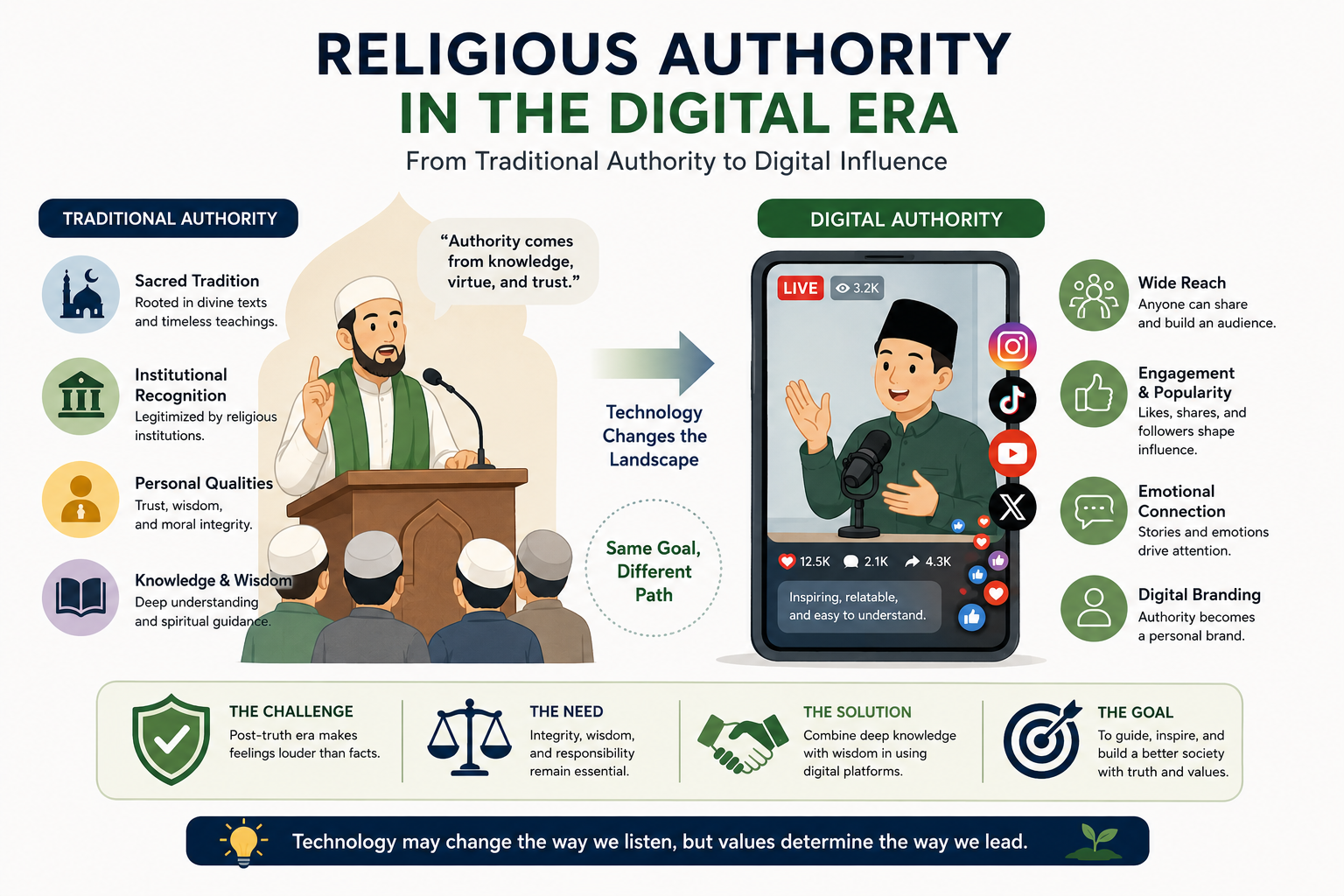
This study examines the shift in religious authority amidst the dominance of social media and the post-truth era. Religious authority, which was once singular and static, now faces the challenges of democratization and fragmentation. Using descriptive qualitative methods and theoretical perspectives ranging from Marshall McLuhan to Bryan S. Turner, this study analyzes the interaction between technology and tradition. The results show that social media has transformed religious authority into a competitive actor in the public arena through digital indicators such as followers, likes, and shares. This phenomenon has triggered the emergence of "Celebrity Ustadz" who often displace traditional ulama due to their expertise in managing algorithms and emotional narratives. In the post-truth era, objective facts tend to be defeated by personal sentiment, forcing authority holders to choose between the depth of knowledge or the relevance of digital aesthetics. In conclusion, social media creates a new ecosystem that redefines religious authority as a "brand" in a highly competitive digital identity market
Downloads
References
Anderson, B. (1983). Imagined Communities: Reflections on the Origin and Spread of Nationalism, Journal of New Media, Wasington.
Campbell, H. A. (2012). Digital Religion: Understanding Religious Practice in New Media Worlds. Routledge
Coke Miriam, & Lawrence B. Bruce, (2005), MUSLIM NETWORK “From Hajj To HipHop”, The University Of North Carolina Press Chapel Hill and London.
Eickelman, D. F., & Anderson, J. W. (2003). New Media in the Muslim World: The Emerging Public Sphere. Indiana University Press.
Foucault, M. (1972). The archaeology of knowledge and the discourse on language (A. M. S. Smith, Trans.). Pantheon Books.
Hoover, S. M. (2011). The media and religious authority. Pennsylvania State University Press.
Hutchings, T. (2022). The Digital Future of Religious Authority. Oxford University Press.
Lim, M. (2017). Freedom to Hate: Social Media, Algorithmic Enclosures, and the Rise of Tribal Nationalism in Indonesia. Critical Asian Studies.
McLuhan, M, (1962). Understanding Media : The Extensions of man. McGraw-Hill.
McLuhan, M. (1995). Understanding media: The extensions of man. MIT Press.
Miles, M. B., Huberman, A. M., & Saldaña, J. (2020). Qualitative Data Analysis: A Methods Sourcebook (4th ed.). SAGE Publications.
Miller, Vincent 2020, Understanding Digital Culture Core, SAGE Publishers.
Soehadha, Moh. (2018) Qualitative Social Research Methods for Religious Studies. Suka - Press, Yogyakarta, 82.
Turner, B. S. (2007). Religious Authority And New Media. Theory, Culture & Society. SAGE Publications.
Turner, B. S. (2008). Religious Nationalism and Religious Markets. In The Religious: Blackwell Companions to Sociology. SAGE Publications.
Downloads
Published
How to Cite
Issue
Section
License
Copyright (c) 2025 Ulil Abdillah

This work is licensed under a Creative Commons Attribution-NonCommercial-ShareAlike 4.0 International License.
This work is licensed under a Creative Commons Attribution-NonCommercial-ShareAlike 4.0 International License.
The copyright of the received article shall be assigned to the journal as the publisher of the journal. The intended copyright includes the right to publish the article in various forms (including reprints). The journal maintains the publishing rights to the published articles. Authors are allowed to use their articles for any legal purposes deemed necessary without written permission from the journal with an acknowledgment of initial publication to this journal.