Optimizing the Role of Teachers and Educators in Realizing Quality Character-Based Education in the Digital Age
DOI:
https://doi.org/10.67046/sjse.v1i02.40Keywords:
teacher,character building, digital eraAbstract
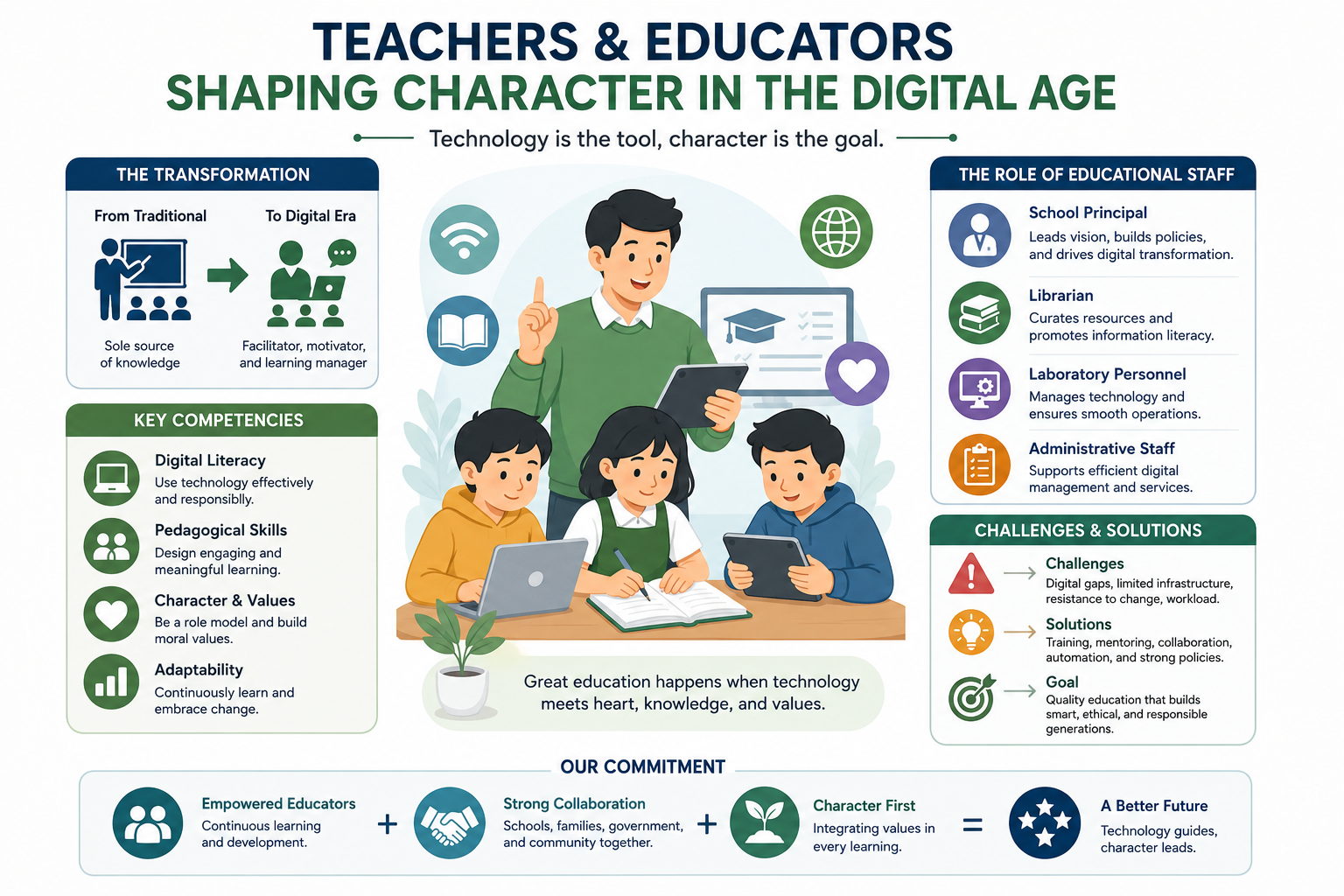
The advancement of digital technology necessitates fundamental transformation in educational practices, particularly regarding the roles of teachers and educational staff. This literature study examines optimization strategies for teachers and educational personnel in realizing quality character-based education amid digital transformation. Through thematic content analysis of recent academic publications, this research reveals three critical findings. First, 60% of teachers possess minimal digital competencies, requiring structured capacity building through tiered training and peer mentoring programs. Second, effective digital education integration demands a three-pillar model comprising professional digital competencies, character-based innovative learning, and educational ecosystem synergy. Third, educational staff including school principals, digital librarians, and laboratory technicians play strategic yet often overlooked roles in creating conducive digital learning environments. The study demonstrates that successful digital education depends not merely on technological sophistication but on educators' capacity to utilize technology as instruments for enhancing learning quality while maintaining character values. This research contributes a comprehensive framework emphasizing the balance between technological mastery and moral value cultivation, proposing systematic professional development programs and multi-stakeholder collaboration to address implementation barriers including digital gaps, infrastructure limitations, and increased workload burdens.
Downloads
References
Booth, A., Sutton, A., & Papaioannou, D. (2016). Systematic approaches to a successful literature review (Second edition). SAGE.
Braun, V., & Clarke, V. (2006). Using thematic analysis in psychology. Qualitative Research in Psychology, 3(2), 77–101. https://doi.org/10.1191/1478088706qp063oa
Cahyani, P., Corebima, A. D., Zubaidah, S., & Mahanal, S. (2021). The study of biology practicum model in institute of teacher education (ITE). Jurnal Cakrawala Pendidikan, 40(3), 772–786. https://doi.org/10.21831/cp.v40i3.30379
Creswell, J. W., & Creswell, J. D. (2018). Research design: Qualitative, quantitative, and mixed methods approaches (Fifth edition). SAGE.
Diana, R. R., Chirzin, M., Bashori, K., Suud, F. M., & Khairunnisa, N. Z. (2021). Parental Engagement On Children Character Education: The Influences Of Positive Parenting And Agreeableness Mediated By Religiosity. Jurnal Cakrawala Pendidikan, 40(2), 428–444. https://doi.org/10.21831/cp.v40i2.39477
Falloon, G. (2020). From digital literacy to digital competence: The teacher digital competency (TDC) framework. Educational Technology Research and Development, 68(5), 2449–2472. https://doi.org/10.1007/s11423-020-09767-4
Fraillon, J., Ainley, J., Schulz, W., Friedman, T., & Duckworth, D. (2020). Preparing for Life in a Digital World: IEA International Computer and Information Literacy Study 2018 International Report. Springer International Publishing. https://doi.org/10.1007/978-3-030-38781-5
Khadijah, K., Suciati, I., Khaerani, K., Manaf, A., & Sutamrin, S. (2021). Schools’ character education values and students’ mathematics learning achievement: A meta-analysis. Jurnal Cakrawala Pendidikan, 40(3), 670–683. https://doi.org/10.21831/cp.v40i3.39924
Layyinah, L., & Roebianto, A. (2020). Uji Validitas Konstruk Pembentukan Karakter Moral Remaja. Jurnal Pengukuran Psikologi Dan Pendidikan Indonesia (JP3I), 9(2), 99–110. https://doi.org/10.15408/jp3i.v9i2.17784
Muhtar, T., & Dallyono, R. (2020). Character Education From the Perspectives Of Elementary School Physical Education Teachers. Jurnal Cakrawala Pendidikan, 39(2), 395–408. https://doi.org/10.21831/cp.v39i2.30647
Mustakim, Z., & Kamal, R. (2021). K-means clustering for classifying the quality management of secondary education in Indonesia. Jurnal Cakrawala Pendidikan, 40(3), 725–737. https://doi.org/10.21831/cp.v40i3.40150
Nanda, A. (2021). Analisis Eksistensi dan Kompetensi Guru dalam Mengajar di Era Society 5.0. Jurnal Inovasi Teknologi Dan Edukasi Teknik, 1(12), 859–864. https://doi.org/10.17977/um068v1i122021p859-864
Rusydiyah, E. F., Purwati, E., & Prabowo, A. (2020). How To Use Digital Literacy As A Learning Resource For Teacher Candidates in Indonesia. Jurnal Cakrawala Pendidikan, 39(2), 305–318. https://doi.org/10.21831/cp.v39i2.30551
Saputra, M., & Siddiq, I. H. A. (2020). Social Media and Digital Citizenship: The Urgency of Digital Literacy in The Middle of A Disrupted Society Era. International Journal of Emerging Technologies in Learning (iJET), 15(07), 156. https://doi.org/10.3991/ijet.v15i07.13239
Snyder, H. (2019). Literature review as a research methodology: An overview and guidelines. Journal of Business Research, 104, 333–339. https://doi.org/10.1016/j.jbusres.2019.07.039
Thohir, M., Maarif, S., Rosyid, J., Huda, H., & Ahmadi, A. (2021). From Disruption to Mobilization: Ire Teachers’ Perspectives on Independent Learning Policy. Jurnal Cakrawala Pendidikan, 40(2), 359–373. https://doi.org/10.21831/cp.v40i2.39540
Zawacki-Richter, O., Marín, V. I., Bond, M., & Gouverneur, F. (2019). Systematic review of research on artificial intelligence applications in higher education – where are the educators? International Journal of Educational Technology in Higher Education, 16(1), 39. https://doi.org/10.1186/s41239-019-0171-0
Downloads
Published
How to Cite
Issue
Section
License
Copyright (c) 2025 Raysa Afifa Amelia, Sakina Radhtul Easy, Shitra Giofika, Rinda Handayani Fathuloh, Ririn Mardana Putri, Selfi Regina Putri, Salsabila, Annisaul Khairat

This work is licensed under a Creative Commons Attribution-NonCommercial-ShareAlike 4.0 International License.
This work is licensed under a Creative Commons Attribution-NonCommercial-ShareAlike 4.0 International License.
The copyright of the received article shall be assigned to the journal as the publisher of the journal. The intended copyright includes the right to publish the article in various forms (including reprints). The journal maintains the publishing rights to the published articles. Authors are allowed to use their articles for any legal purposes deemed necessary without written permission from the journal with an acknowledgment of initial publication to this journal.