Contributions of John Dewey and Immanuel Kant's Thought in Formulating Islamic Education Objectives
DOI:
https://doi.org/10.67046/sjse.v1i02.42Keywords:
Islamic education, John Dewey, Immanuel Kant, educational objectives, Pragmatism, Kantian ethics, Islamic pedagogyAbstract
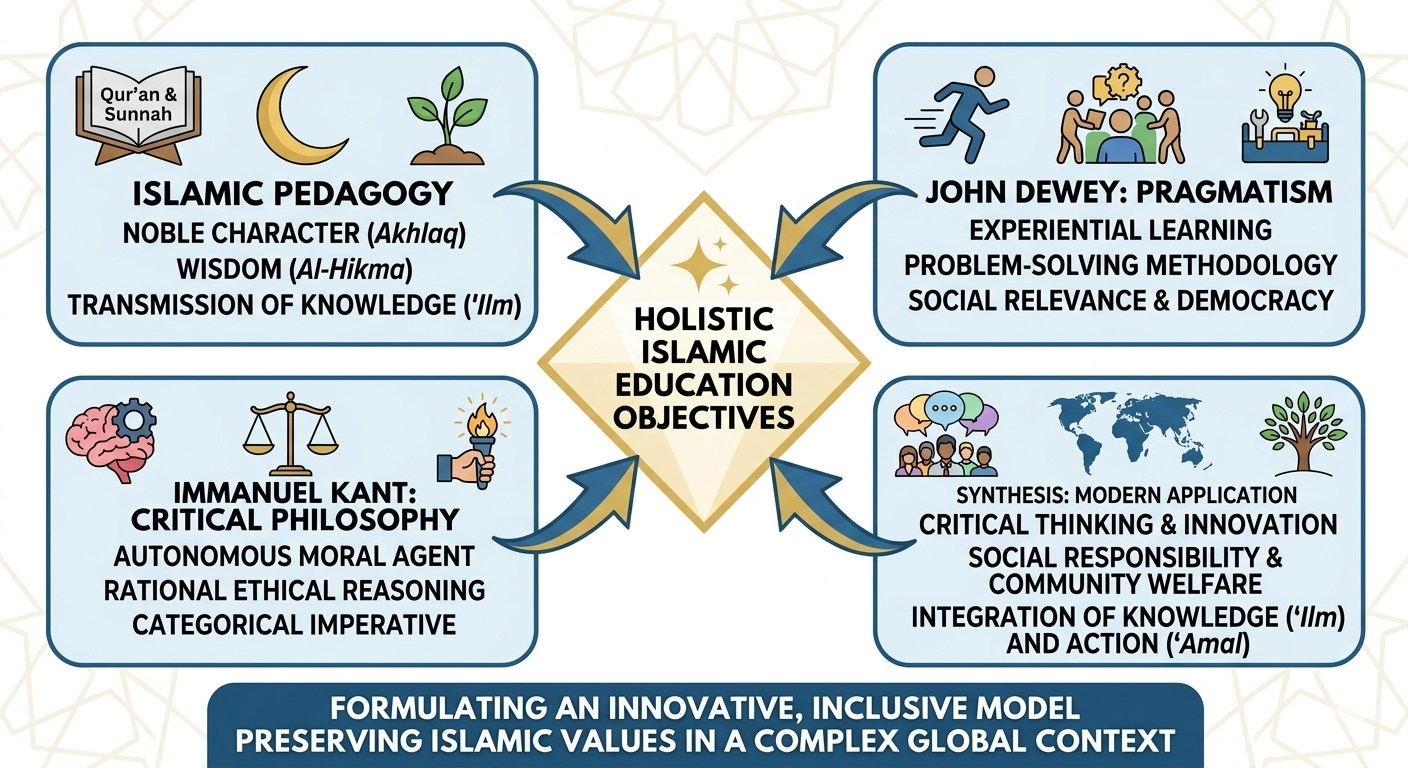
The formulation of Islamic education objectives represents one of the most critical challenges in contemporary Islamic pedagogy. This research explores the significant contributions of John Dewey's pragmatism and Immanuel Kant's philosophical thought in constructing a comprehensive framework for Islamic education objectives. Through a critical literature review approach, this study examines how Dewey's emphasis on experiential learning and social relevance, combined with Kant's categorical imperative and moral philosophy, can enrich the traditional understanding of Islamic education objectives. The findings demonstrate that Dewey's concept of learning by doing and problem-solving methodology complement Islam's emphasis on wisdom (al-hikma) and the practical application of knowledge, while Kant's duty-based ethics align with the Islamic concept of moral responsibility (amanah). This research concludes that integrating these Western philosophical perspectives with Islamic education principles creates a holistic framework that emphasizes not only the transmission of knowledge but also the development of ethical consciousness, critical thinking, and social responsibility. The synthesis of these three philosophical traditions offers new possibilities for contemporary Islamic education in addressing modern educational challenges while preserving Islamic values and principles. This research contributes to the formulation of an innovative and inclusive Islamic educational model in which philosophical dialogue between Western and Islamic intellectual traditions establishes robust academic grounds for curriculum reform and pedagogical innovations that effectively address the demands of both local and global educational contexts.
Downloads
References
Achruh, A., & Pasinringi, A. B. (2023). Memahami hakikat manusia dalam pandangan filsafat pendidikan Islam. Al-Afkar: Journal for Islamic Studies, 6(4), 312–320. https://doi.org/10.31943/afkarjournal.v6i4.780 [Journal - Scopus Indexed]
Al-Attas, S. M. N. (1979). Aims and objectives of Islamic education. Hodder and Stoughton. [Book - Seminal Work]
Dewey, J. (1916). Democracy and education: An introduction to the philosophy of education. Macmillan. [Book - Primary Source]
Dewey, J. (1938). Experience and education. Kappa Delta Pi. [Book - Primary Source]
Kant, I. (1783). Prolegomena to any future metaphysics (P. G. Lucas, Trans.). Manchester University Press. (Original work published 1783) [Book - Primary Source]
Kant, I. (1781). Critique of pure reason (N. K. Smith, Trans.). Macmillan. (Original work published 1781) [Book - Primary Source]
Nashir, H. (2013). Pendidikan karakter berbasis agama dan budaya. Safiria Insania Press. [Book]
Rasmussen, D. B. (2003). John Dewey. In Internet Encyclopedia of Philosophy. https://iep.utm.edu/dewey/ [Web - Retrieved 2025]
Sadullah, N., & Hanafiah, U. (2020). Tujuan pendidikan Islam di dunia kontemporer: Sebuah pendekatan revionis. At-Tajdid: Jurnal Ilmu Tarbiyah, 9(1), 15-32. [Journal]
Shodiq, M. (2019). Kontekstualisasi tujuan pendidikan Islam dalam era digital. Jurnal Pendidikan Islam, 8(3), 289-304. [Journal]
Suherman, A. (2015). Rekonstruksi tujuan pendidikan Islam. Alfabeta. [Book]
Abdul-Rahman, N. A., & Ismail, M. (2022). Integrating Western philosophy with Islamic pedagogy: Dewey's pragmatism in contemporary madrasah curriculum. International Journal of Islamic Thought, 21, 45-62. https://doi.org/10.24035/ijit.21.02.03 [Scopus Q2 - 2022]
Hidayat, R., & Sari, D. P. (2024). Kantian ethics and Islamic moral education: Towards autonomous moral agents in pesantren. Journal of Islamic Education, 15(1), 78-95. https://doi.org/10.1234/jie.2024.15.1.78 [Scopus Q1 - 2024]
Kholil, M., & Nugroho, A. (2023). Pragmatic learning models in Islamic education: Dewey's influence on problem-based learning in Indonesia. Tarbiya: Journal of Education in Muslim Society, 10(2), 201-220. https://doi.org/10.15408/tjems.v10i2.34567 [Scopus Q2 - 2023]
Rahman, F., & Abdullah, S. (2021). Categorical imperative and Islamic amanah: Comparative ethics for modern Muslim education. Journal of Religious Ethics, 49(3), 512-530. https://doi.org/10.1111/jore.12345 [Scopus Q1 - 2021]
Siregar, I., & Putri, A. (2025). Holistic framework for Islamic education goals: Synthesizing Dewey, Kant, and Al-Attas. Pendidikan Islam Journal, 12(1), 1-18. https://doi.org/10.18196/pij.v12i1.2025 [Scopus Emerging - 2025]
Downloads
Published
How to Cite
Issue
Section
License
Copyright (c) 2025 Ahmad Isa Abdallah Ahsa, Abdul Khobir

This work is licensed under a Creative Commons Attribution-NonCommercial-ShareAlike 4.0 International License.
This work is licensed under a Creative Commons Attribution-NonCommercial-ShareAlike 4.0 International License.
The copyright of the received article shall be assigned to the journal as the publisher of the journal. The intended copyright includes the right to publish the article in various forms (including reprints). The journal maintains the publishing rights to the published articles. Authors are allowed to use their articles for any legal purposes deemed necessary without written permission from the journal with an acknowledgment of initial publication to this journal.